
Ashok Kumar Paswan
 Mithila (Madhubani) folk painter
Laheriyaganj, Madhubani, Bihar
Ashok Kumar Paswan is a Mithila (Madhubani) folk painter from Laheriyaganj in the Madhubani district of Bihar. Born on 3 February 1970 into a family with a strong tradition of Mithila art, he grew up surrounded by the cultural and religious life of the region, and his paintings carry forward the customs that Mithila art has preserved for generations.
He learned the art from his elder brother and has practised it ever since. His work has received several honours, including the State Award in 1987–88 for his painting Raja Shlesh, and he has been commissioned to create artwork for government and private organisations.
Beyond his painting, Ashok Paswan is a respected member of his community. He has long been an advocate for education, working to improve literacy in his village, and he has organised workshops and exhibitions to showcase the cultural heritage of Mithila. Through his work, he has helped bring wider recognition to this vibrant art form and has inspired many younger artists to carry the tradition forward.
Read less ↑- Painter
- Mithila / Madhubani folk art
- Madhubani, Bihar
- State Award, 1987–88
Paintings
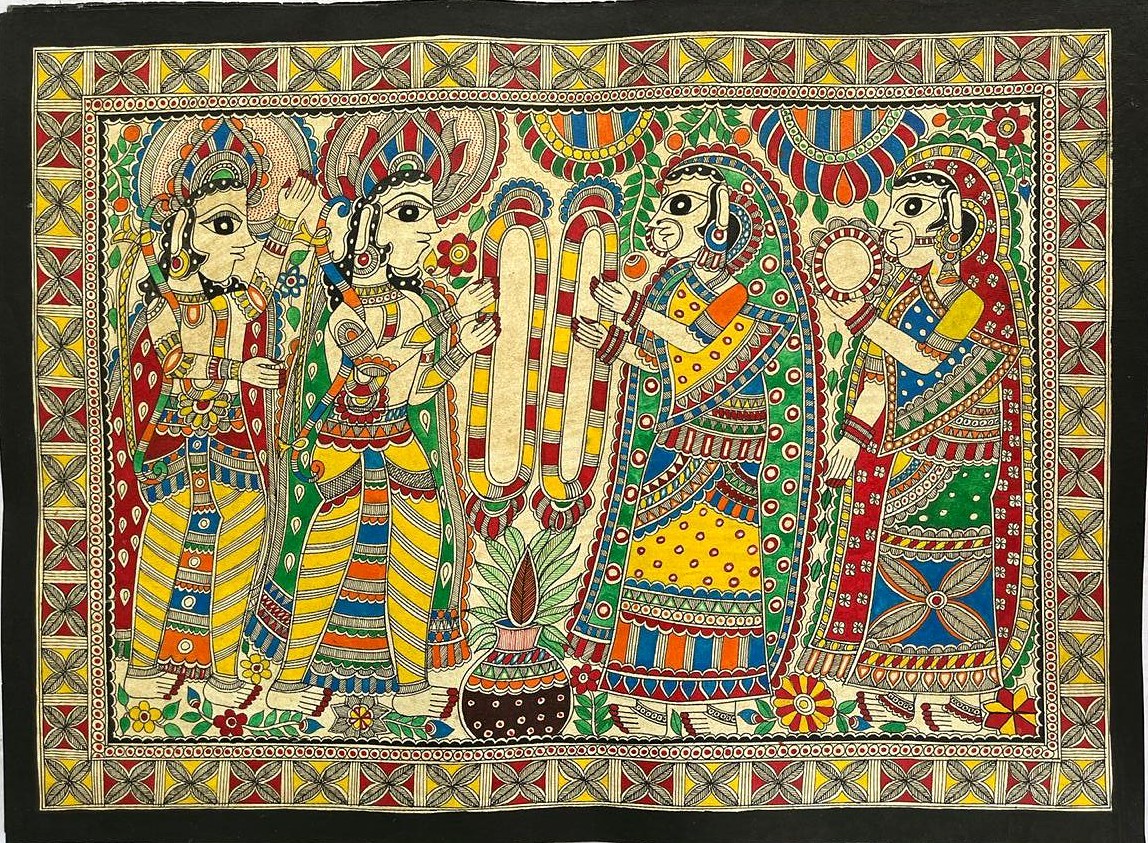
Sita’s Jaimala
A wedding scene from the Ramayana as Mithila remembers it. On the left stand Rama and Lakshmana, crowned and haloed, bows on their shoulders. Facing them, Sita lifts a long flower garland towards Rama in the jaimala, the exchange of garlands that seals the marriage, while a companion behind her holds up a round mirror for the bride.
Between them stands a kalash, a sacred water pot crowned with mango leaves, the auspicious centre of every Mithila wedding. Lotus and flower motifs fill the ground, and a border of four-petal flowers in red and yellow frames the scene.
The figures are drawn in the classic Mithila manner: large eyes in profile, long noses, and garments built from bands of stripes, dots and leaf patterns. Bright yellow, red, green and blue set against the pale paper give the painting the festive brightness of a wedding courtyard.
Read less ↑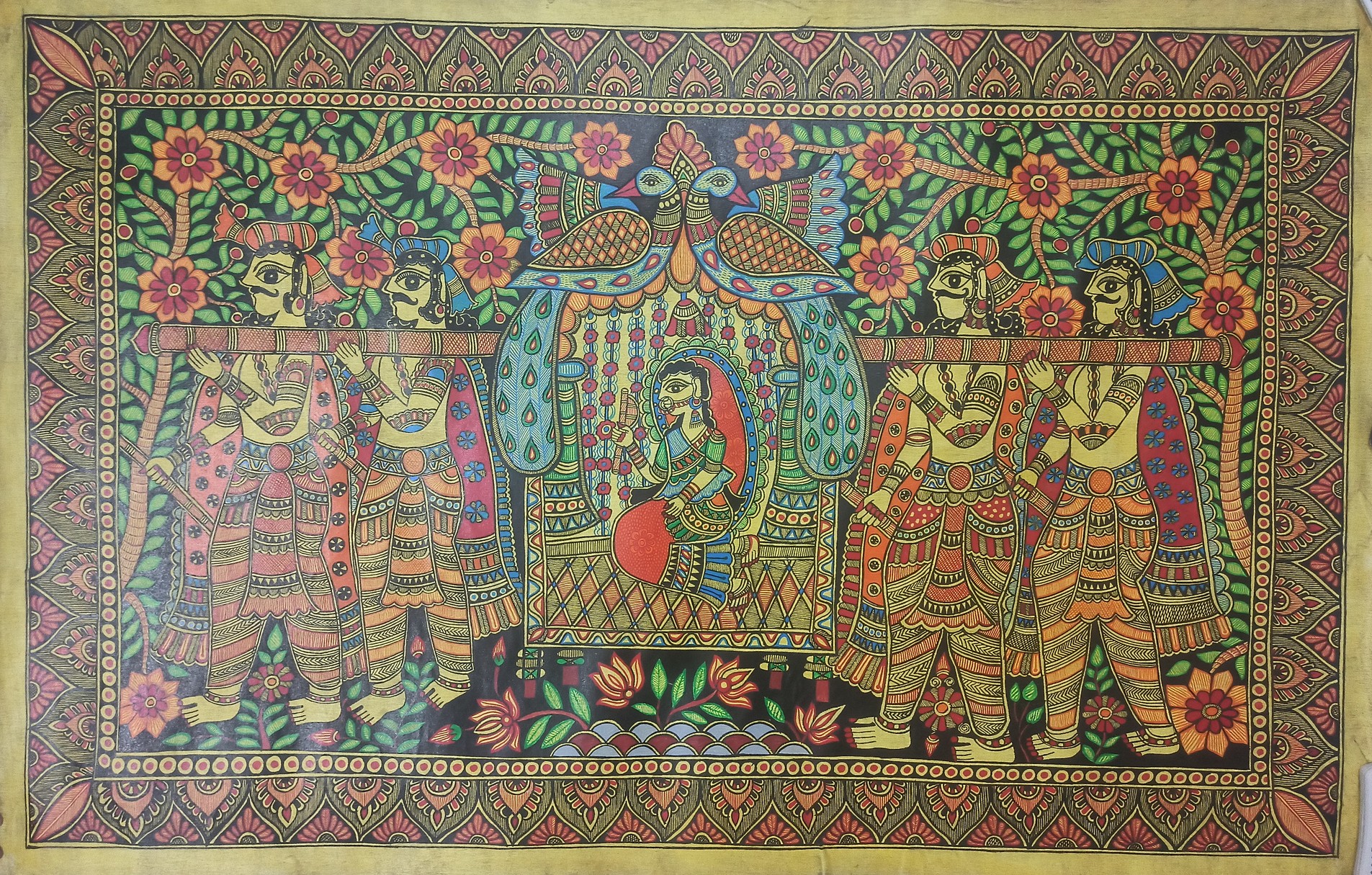
The Bride’s Doli
A bridal procession moves across the painting. Four bearers in bright turbans carry a doli, a palanquin, on a long pole across their shoulders, two in front and two behind. Seated inside is the bride, adorned and veiled, on her way from her parents’ home to her new life after the wedding. In Mithila’s visual tradition the scene recalls the bidaai of Sita, who left Janakpur, the land of Mithila, as the bride of Rama: a moment of joy, blessing and gentle sorrow at once.
Two peacocks meet above the palanquin, their tails falling like a canopy over the bride. In Mithila painting the peacock is a symbol of love and auspicious union. Flowering trees fill the background, lotuses and water waves run along the base, and a double border of petal and leaf motifs frames the whole composition.
What makes the work remarkable is its detail. Every surface is alive: bold black outlines are filled with fine, thin brush lines, parallel strokes, dots and tiny patterns, so that clothes, jewellery, leaves and feathers all carry their own texture. The vibrant palette of turmeric yellow, vermilion red, orange, leaf green and peacock blue, set against a deep black ground, follows the natural colours of the Mithila tradition and gives the painting its glowing, festive energy.
Read less ↑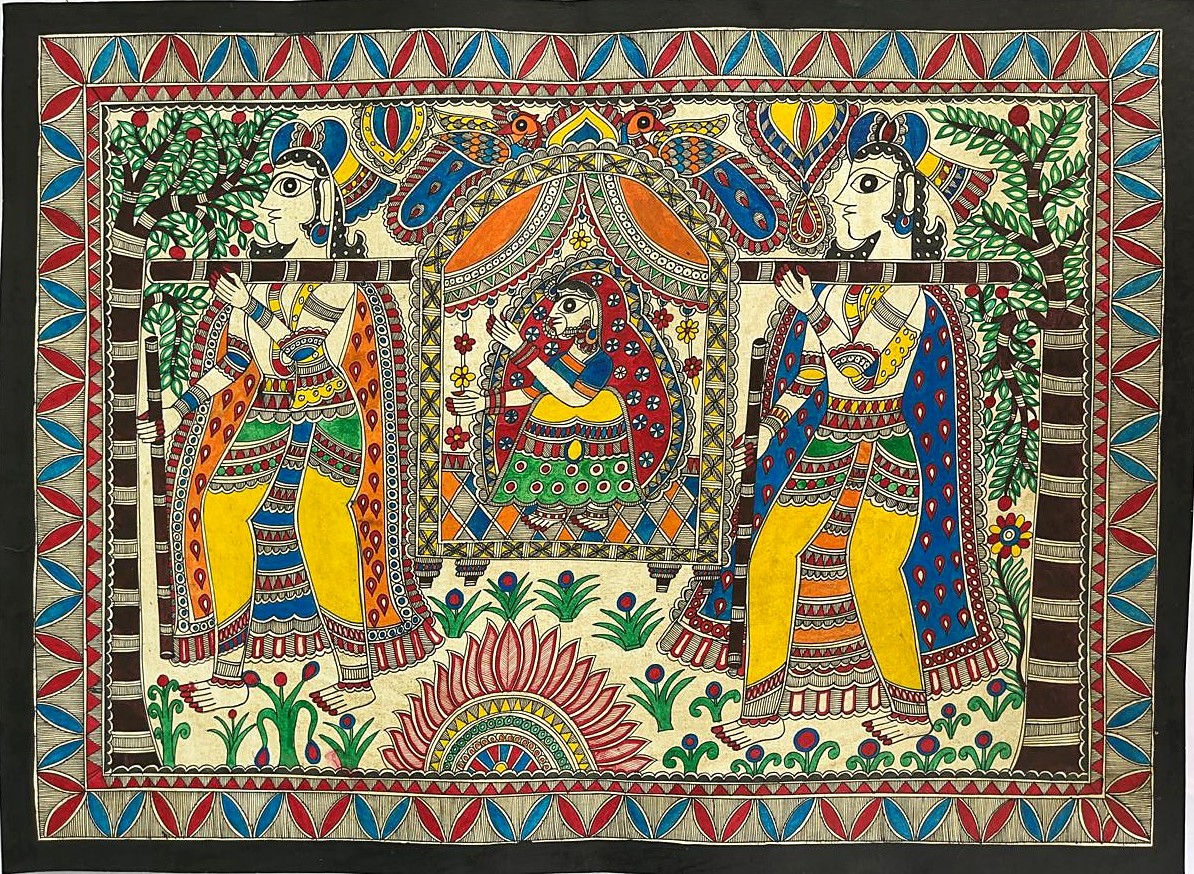
The Doli Under the Sun
A second take on the bridal journey. Two bearers carry the doli on a long pole, and in the decorated palanquin between them sits the veiled bride, a small parrot-shaped ornament hanging from the roof. Here the composition is calmer and more symmetrical, with the palanquin set in the exact centre of the painting.
A large blossoming sun-flower rises over the scene, with lotus buds and plants below the bearers’ feet and leafy trees at each end. In Mithila painting the sun, the lotus and the parrot are all signs of blessing, love and fertility for the new couple.
A border of red and blue petals and a band of brown and cream stripes frame the procession. The fine black outlines, the dotted patterns on clothing and the clear blocks of yellow, orange, green and blue show the artist’s careful balance of line and colour.
Read less ↑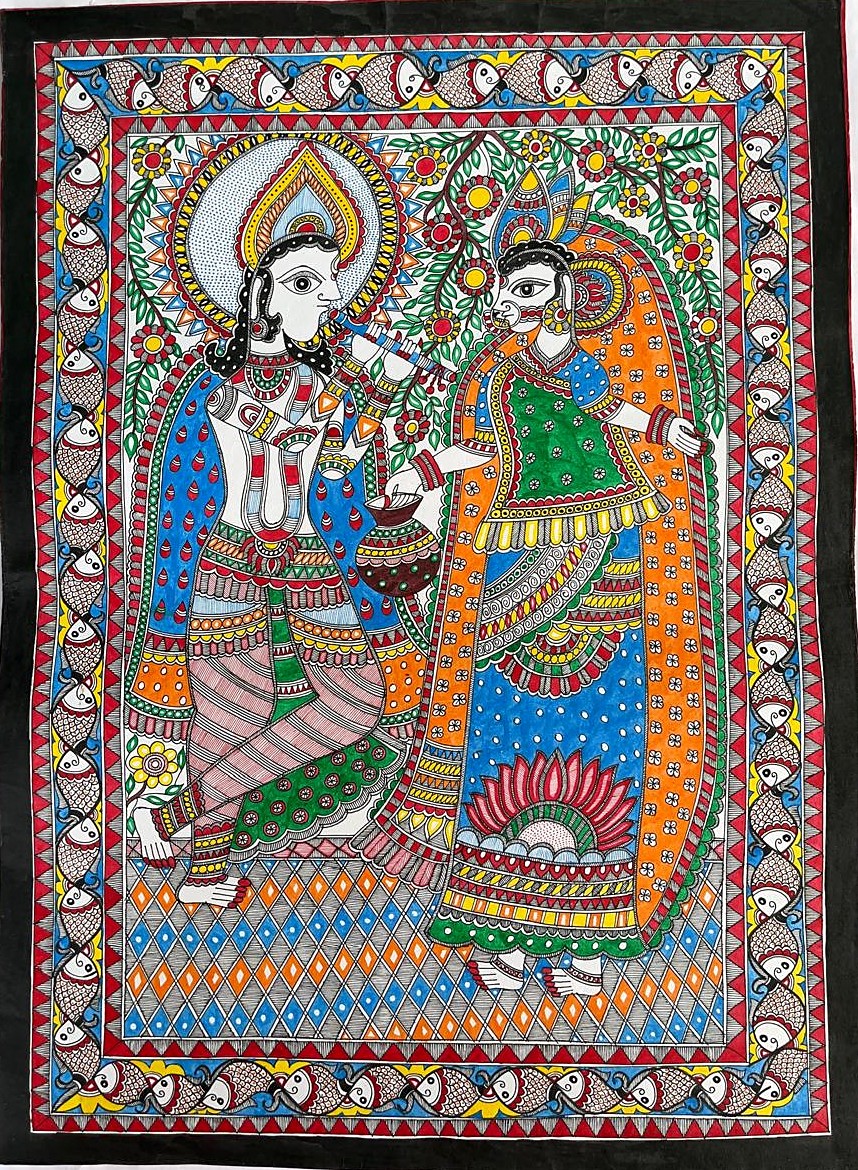
Radha and Krishna
Krishna stands on the left, playing his flute, with a peacock-feather crown and a glowing halo. Radha faces him, dressed in a richly patterned orange and green sari, holding out a small pot, perhaps of butter or curd, which recalls the playful stories of Krishna and the gopis of Vrindavan.
Above them, a flowering tree spreads its branches; below, a large lotus blooms at Radha’s feet, and a diamond-patterned floor in blue, orange and green gives the scene depth. The double border of paired fish, a classic Mithila symbol of love, fertility and good fortune, makes this a fitting image of devotion and union.
Every surface carries its own pattern: stripes, dots, leaves and tiny repeated shapes fill the clothes and the background, drawn with a fine thin brush and filled with clear, vivid colour.
Read less ↑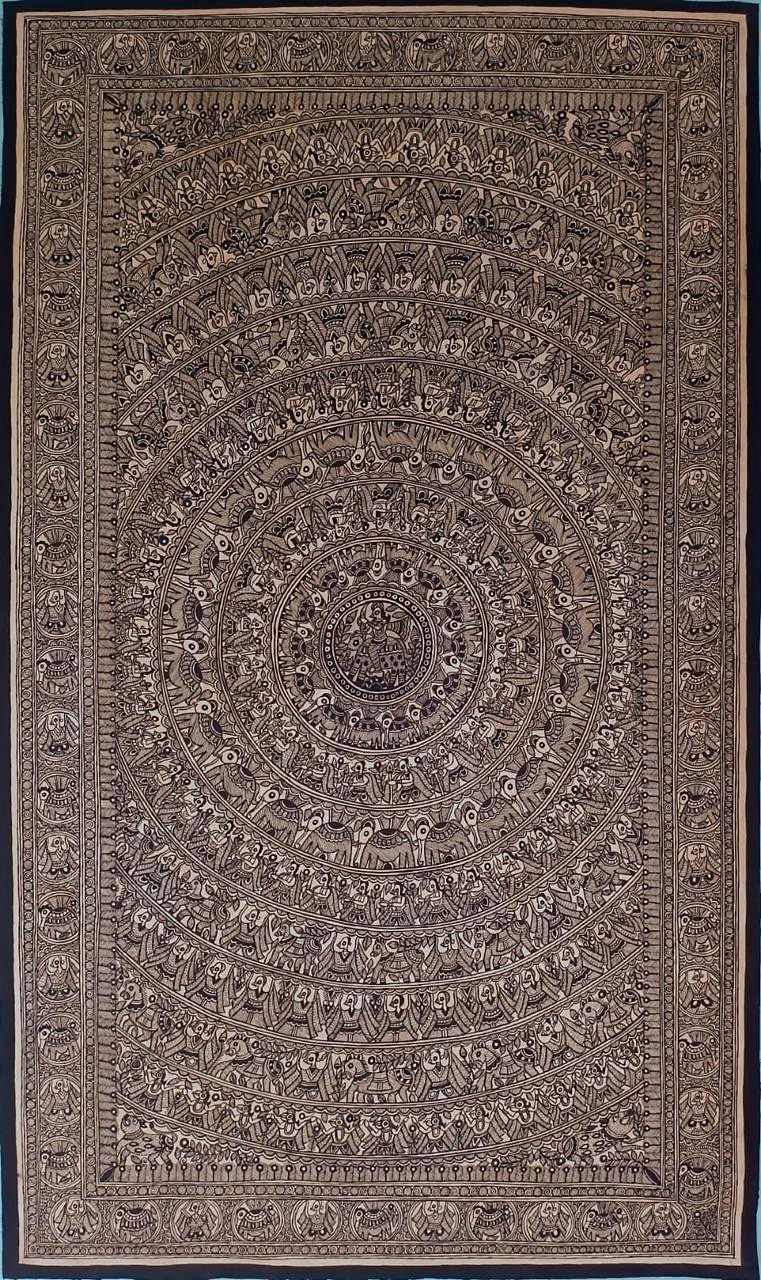
The Royal Procession
A remarkable work in pure line. At the very centre, a royal figure rides an elephant, and around him ring after ring of figures move in a great circle: elephants, horses, peacocks, birds and people walking in procession, as if the whole world has turned out to celebrate. The circles widen outwards until they fill the rectangle of the painting.
This is kachni, the line-work style of Mithila painting, in which images are built entirely from fine strokes, hatching and dots, with no colour filling. Painted in black on a warm, cream-toned paper, it rewards slow looking: each tiny figure is individually drawn, and the borders are made of small medallions, each holding its own bird or figure.
The scale and patience of this piece show the discipline of the tradition, in which a single steady hand repeats a motif hundreds of times without losing its rhythm.
Read less ↑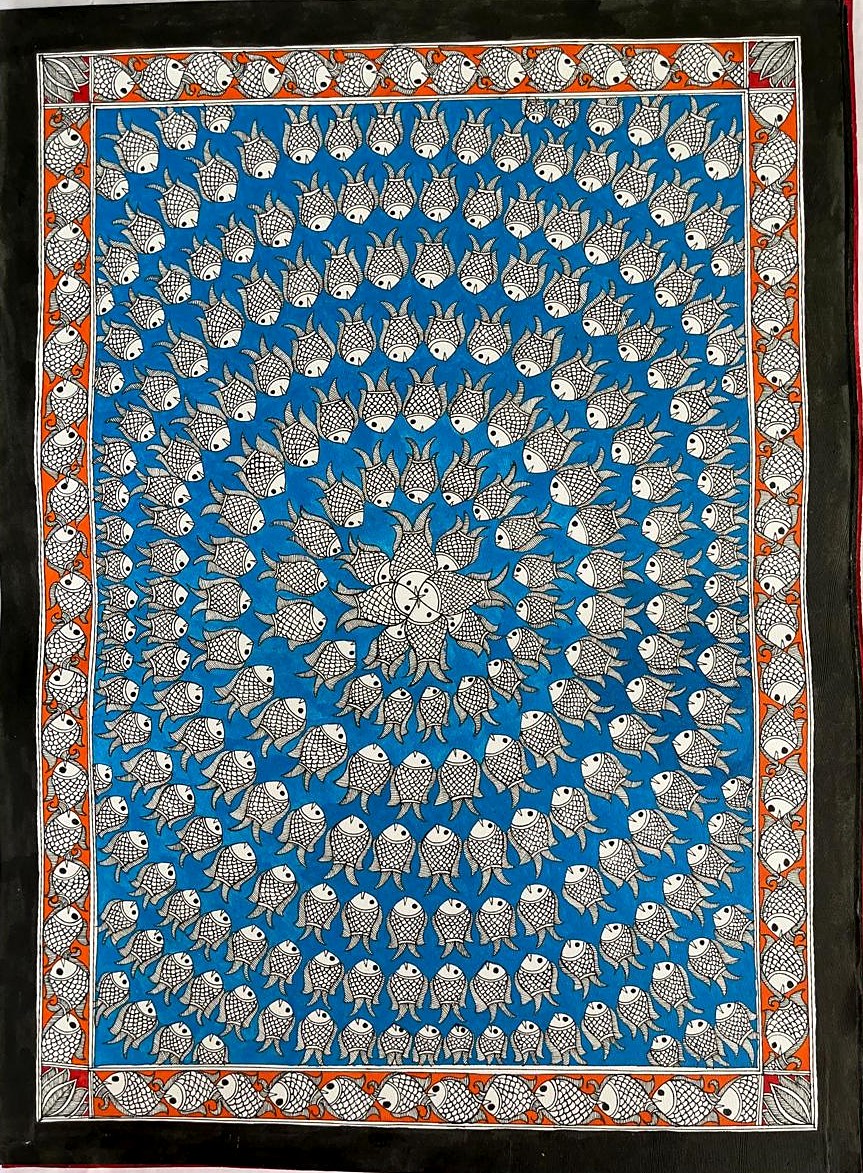
A Pond of Fish
Hundreds of white fish swim in rings around a central flower formed by fish meeting head to head, all on a deep blue ground. The movement spirals outwards from the centre, so the painting seems to turn as you look at it.
Fish, machh, are among the most important symbols in Mithila art. They stand for fertility, abundance and good luck, and they appear in wedding paintings and on the walls of the kohbar ghar, the bridal chamber. Here the artist makes the fish the whole subject.
Each fish is drawn with fine cross-hatched scales, a round eye and feathery fins in black line on white. A bright orange border filled with more fish frames the composition, a striking contrast with the calm blue water.
Read less ↑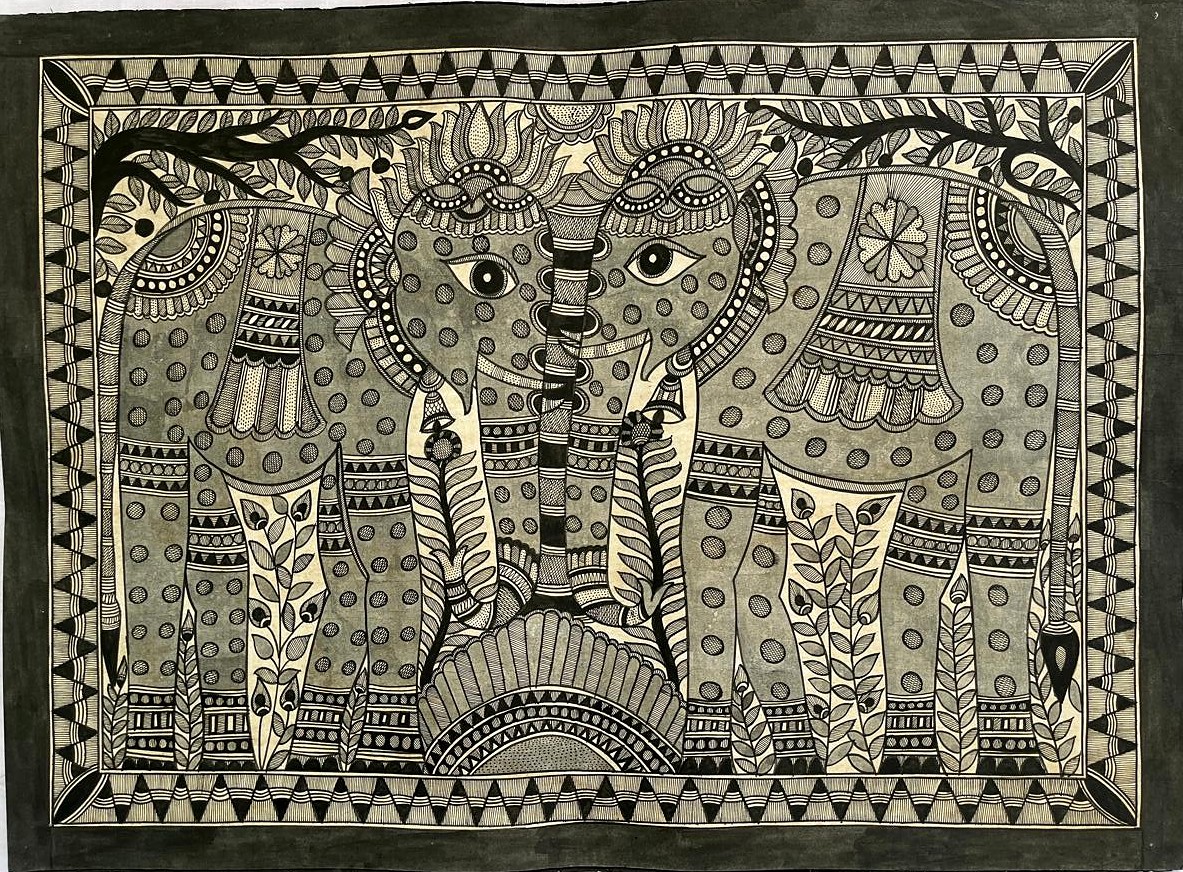
Twin Elephants
Two richly decorated elephants face each other, their trunks raised and touching at the centre of the painting. Each wears an ornamented headdress and a patterned blanket, and their bodies are covered with dots, stripes and leaf designs.
The elephant is a royal and auspicious animal in Mithila art, a sign of strength, prosperity and good fortune, and it often appears in wedding and festival paintings. Placed symmetrically with flowering trees at the corners and a half-sun between their feet, the pair suggests harmony and partnership.
Painted in black line and grey wash on cream paper, with a bold border of triangles, the work shows how much texture the artist can create with only line, shading and pattern.
Read less ↑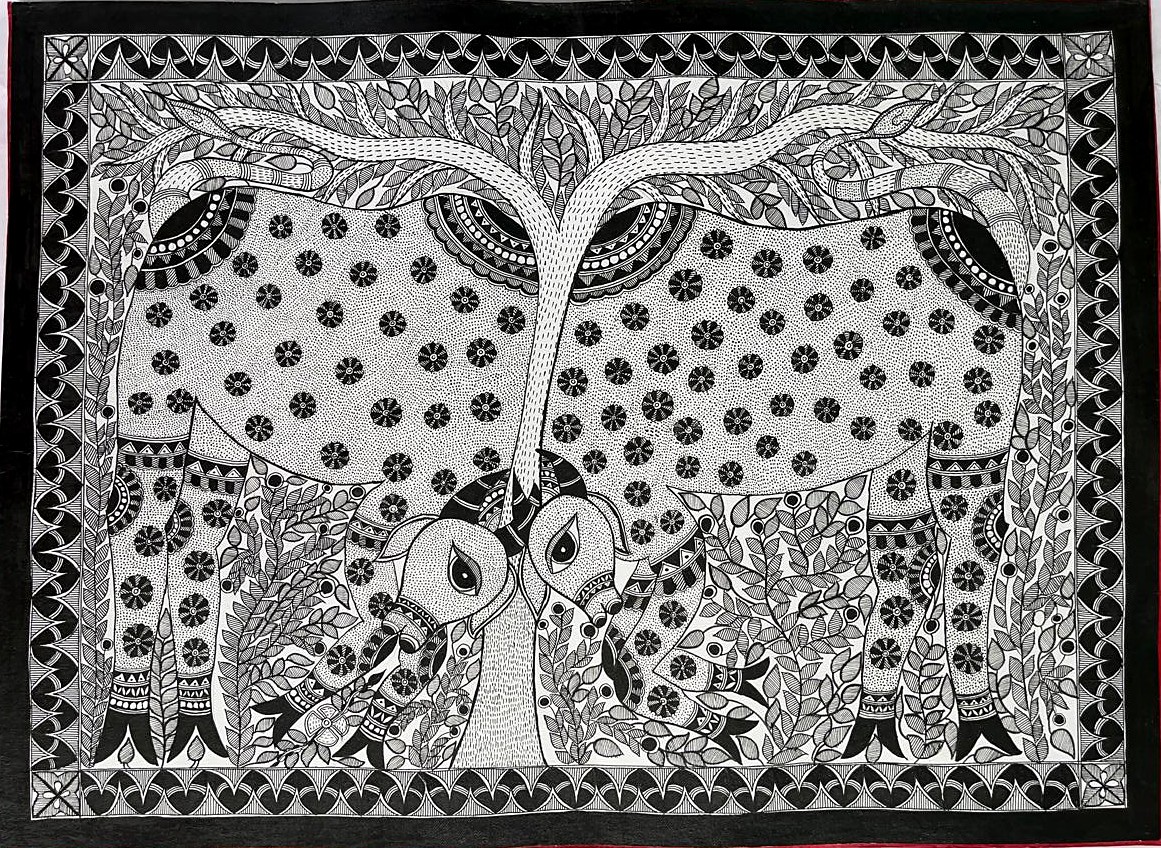
Cows Beneath the Tree of Life
Two cows stand beneath a great spreading tree, their heads lowered and turned towards each other at its trunk. Their bodies are covered with flower-shaped spots, and dense leaves and branches fill every remaining space around them.
The cow is sacred in Mithila and across India, a symbol of motherhood, nourishment and plenty, and the tree is a familiar image of life and continuity. Together they make a gentle picture of care and abundance in village life.
Drawn entirely in fine black line on white, this painting shows the kachni technique at its most delicate: thousands of small dots for texture, tiny leaves drawn one by one, and a strong black border with a scalloped pattern holding the composition together.
Read less ↑