Wisdom in the Village
 Rajeev Kumar
Research Scholar, Civilization Studies, Ibn Haldun University, Istanbul
~ 4 min read
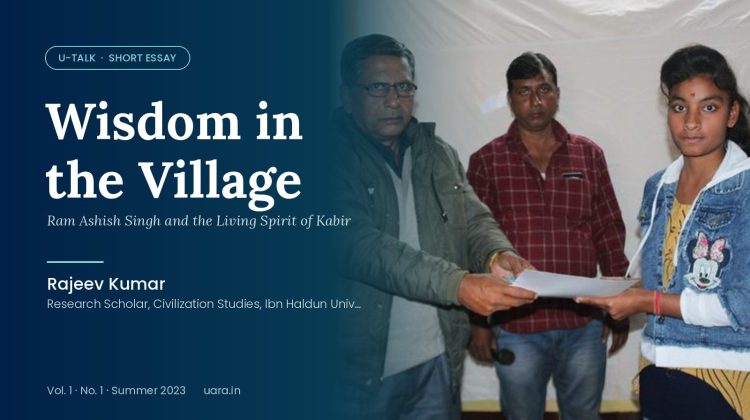
Guru Ram Ashish Singh is a name held in great respect in his hometown. A retired government schoolteacher, he is one of the most learned individuals in Jaynagar (Bihar), my hometown. I had the honor of meeting him recently when he came to our home for my grandmother’s funeral. Even during my school days, he was one of my teachers and is a close friend of my father.
During our conversation, I shared with him my Master’s thesis on Kabir, which highlights Indo-Islamic relations, and spoke about my continued research on the same topic for my PhD. To my delight, he had much to say on the subject. He described Kabir as a great figure who emerged at a time when religious orthodoxy in both Hinduism and Islam was at its peak. Kabir held a unique vision and openly challenged dogmatism and fanaticism in both religions.
Guru Ram Ashish Singh shared a couplet by Kabir that critiques religious orthodoxy within Muslim communities:
“Kankar pathar jori kai masjid laee banay,
Ta chadhi mulla baang de, kya bahra hua Khuday.”
Kabir is questioning the external display of religiosity without inner spiritual connection. He critiques the ritualistic shouting of prayer from a man-made structure as if God needs loud reminders. His deeper message is: True divinity doesn’t require noise or spectacle—God resides in silence and inner awareness.
True divinity doesn’t require noise or spectacle—God resides in silence and inner awareness.
He also recited another famous couplet by Kabir that critiques Hindu orthodoxy:
“Pathar pooje Hari mile, to main poojun pahaar,
Taate to chakki bhali, pees khaye sansaar.”
Kabir mocks the idol worship practiced without understanding. He says if worshipping a lifeless stone brought God, then a mountain would be more worthy of reverence. But even better is the grinding stone (chakki)—it does real work and sustains people’s lives.
Guru Ram Ashish Singh explained that Kabir offered society a new vision and perspective. He conveyed a message of love and harmony that broke through the barriers of caste and religion. Kabir’s message was troubling to orthodox Hindus and Muslims who practiced religious dogma. However, his words deeply resonated with the backward castes and marginalized communities who were historically oppressed and excluded. Kabir was a foundational poet whose verses were grounded in his experiences and his observations of the world around him.
In addition to his vast knowledge of literature and philosophy, Guru Ram Ashish Singh is one of the rare individuals who holds a Master’s degree in mathematics. During our conversation, he shared many stories from his life. Despite a difficult childhood, he remained devoted to his studies and earned his bachelor’s degree by the age of 22. He then secured a government teaching job and offered private tuitions to students from grades 7 to 10. He was highly respected by his students, and due to his knowledge and engaging teaching methods, his school was always full of eager learners.
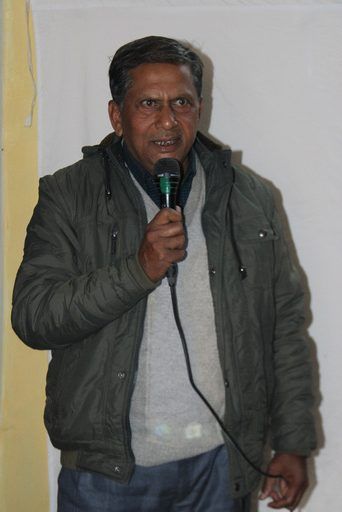
Guru Ram Ashish Singh has always emphasized the importance of deep knowledge in any subject. He taught underprivileged students free of cost and supported them financially whenever needed. Even after retirement, he continues to teach many students for free in his village.
When asked how he developed an interest in literature despite his background in science, he spoke about his teacher and mentor, Ram Vishesh Thakur. Guru Ram Vishesh Thakur was a kind and scholarly man who taught him Hindi literature. Initially, Guru Ram Ashish Singh was hesitant to learn Hindi literature and expressed concern that his mother tongue, Maithili, might make it difficult. However, Guru Ram Vishesh Thakur encouraged him, gave him good Hindi books to read, and even came to his home to teach him when he couldn’t visit.
Such is Guru Ram Ashish Singh’s devotion to knowledge and wisdom that he worships only books and learning—not deities or temples. He believes that people of all religions should possess compassion, and to him, those who do are truly religious.
Such is Guru Ram Ashish Singh’s devotion to knowledge and wisdom that he worships only books and learning—not deities or temples.
Both Guru Ram Ashish Singh and his wife are retired government teachers and are vegetarians. They hold great reverence for Kabir and other revered figures. When asked about his views on Muslims and Islam, he remarked that Muslims often believe theirs is the only true religion. At the same time, he acknowledged that Hinduism has its own problems too.
Guru Ram Ashish Singh’s dedication to learning and knowledge is truly inspiring. His passion for education and his willingness to help others are evident in the countless hours he has spent teaching students, both inside and outside the classroom. He is a shining example of how education can transform lives and empower individuals to achieve their goals.
In a society still bound by caste, religion, and gender divisions, Guru Ram Ashish Singh’s belief in the power of knowledge to break barriers and create a more just society is truly remarkable. His unwavering commitment to teaching and supporting those in need is a testament to the idea that education can be a force for good and a catalyst for change.
I bid him farewell for now, grateful for the opportunity to learn from him and to deepen my understanding of Kabir’s poetry and his message of love and harmony. The life and work of Guru Ram Ashish Singh have left a lasting impact on his students and community. In many ways, he stands as a living legacy of Kabir—someone who not only teaches but lives the values of compassion, wisdom, and resistance to injustice that Kabir stood for.
In the end, Guru Ram Ashish Singh embodies the spirit of a true teacher and a lifelong learner. His intellect, humility, and unwavering dedication to education and social justice are truly remarkable—and he continues to be a powerful inspiration for all of us.
Rajeev Kumar is a research scholar in Civilization Studies at Ibn Haldun University, Istanbul, Turkey.