Kahai Kabir, Kachu Kahat Na Aavai
 Prof. Raziuddin Aquil
Indian Historian, Department of History, University of Delhi
~ 3 min read
In the context of social justice and communal harmony, it is essential to acknowledge the enduring relevance of Sant Kabir’s extraordinary life, his compositions, and the legends surrounding him. This is particularly significant because critical questions, pressing issues, and progressive ideas are often suppressed by aggressive religious mobilization and political violence.
Kabir stands as a living embodiment of North India’s composite culture. During the Lodi-Afghan rule, he emerged as a revolutionary bhakti saint who challenged social hierarchies, caste-based discrimination, and religious hypocrisy. He is celebrated for his fierce critique of organized religion, targeting not only Hindu and Muslim clerics but also self-proclaimed Sufis and Yogis of his time. Kabir called for peaceful coexistence between different religious sects and communities, advocating a spiritual path beyond rigid institutionalized doctrines.
Kabir’s worldview can be understood through several key aspects. He was deeply critical of religious institutions and their deceptive practices, often exposing the hypocrisy of both Hindu and Muslim clergy. His teachings strongly denounced caste-based social stratification, challenging the rigid hierarchies that justified discrimination and oppression. Kabir also questioned the deeply entrenched patriarchal attitudes toward women, offering a thought-provoking challenge to conventional norms. Additionally, he condemned ritualistic animal sacrifices, criticizing both the Hindu practice of offering animals in religious ceremonies and the Muslim tradition of ritual slaughter.
Kabir advised people to seek divinity within their hearts, rather than through outward rituals. He likened the human heart to a mirror that must be cleansed of impurities to reflect the divine truth:
Jau darasan dekhya chaahiye, tau darpan manjat rahiye
Jab darpan laage kaayi, tab darasan kiya na jaayi!
(If you wish to see the divine vision, then keep your mirror clean.
If dirt settles on the mirror, how will you behold the reflection?)
In the medieval Sufi-Bhakti tradition, the formless God was addressed through various names—Allah, Ram, Rahim, Khuda, or Alakh Niranjan. Kabir emphasized the unity of God, stating that the Creator (Khaliq) and His creation (Khalq) are not separate but one:
In the medieval Sufi-Bhakti tradition, the formless God was addressed through various names—Allah, Ram, Rahim, Khuda, or Alakh Niranjan.
Khaalik Khalak, Khalak mein
Khaalik Sab ghat rahiyo samaai!
(The Creator resides within His creation,
He pervades all existence!)
Like many Sufi saints and Bhakti poets, Kabir rejected religious divisions altogether:
Kahen Kabir ek Ram japahu re,
Hindu Turk na koi!
(Chant only the name of one true Ram,
For neither Hindu nor Turk (Muslim) truly exists!)
Kabir’s language of devotion transcended communal barriers, and his teachings were revered across religious lines. This appreciation of his philosophy is reflected in Nabhadas’s Bhaktamal (circa 1600 CE), which describes Kabir as someone who spoke impartially for the welfare of all:
Hindu-Turk pramaan ramaini sabdi saakhi
Pachhpaat nahi bachan sab hi ke hit ki bhaashi!
(Hindu or Muslim, the proof resides in the sacred words,
No bias in the speech, it speaks for the good of all worlds.)
Around the same time, Anantadas wrote Parachai, a collection of biographical accounts of North India’s most influential Bhakti poets of the 15th and 16th centuries. He highlighted how Sant Ravidas and Dadu Dayal—both from marginalized communities—tried to convince Kabir to rise above the Nirgun-Sagun (formless vs. idol worship) debate. Ravidas, in particular, argued that both forms of worship are part of the same divine reality, offering a metaphor:
“Saguna (God with form) is like butter,
Nirguna (formless God) is like ghee!”
However, the real battle was not about theological differences but about dismantling caste-based divisions. Kabir was uncompromising in his mission to challenge social hierarchies, willing to go to any extent to question Brahminical supremacy and Shudra oppression.
But did these saints succeed in their efforts?
Even today, social divisions, caste-based discrimination, and religious fanaticism remain prevalent. Society still needs to learn from Kabir’s philosophy, which emphasizes that the true divine resides within one’s heart—not in temples or mosques. Since many marginalized communities were historically denied access to temples, Kabir posed a simple yet profound question:
“If God truly dwells in the stone idol,
Then why not worship the entire mountain?”
He also challenged the monopoly of Brahmins over sacred scriptures and knowledge. Instead of formal education, he upheld a simple yet profound truth:
“True wisdom lies not in scholarly debates,
But in understanding the essence of love.”
For Kabir, true religiosity meant fostering love and harmony among people. To achieve this, one had to break free from the societal cages imposed by rigid traditions. He dedicated his entire life to this pursuit, embracing complete spiritual and social liberation.
Even today, Kabir’s words echo as a powerful critique of oppression and blind ritualism, urging humanity to seek truth, compassion, and unity beyond artificial barriers.
Even today, Kabir’s words echo as a powerful critique of oppression and blind ritualism, urging humanity to seek truth, compassion, and unity beyond artificial barriers.
References & Credits
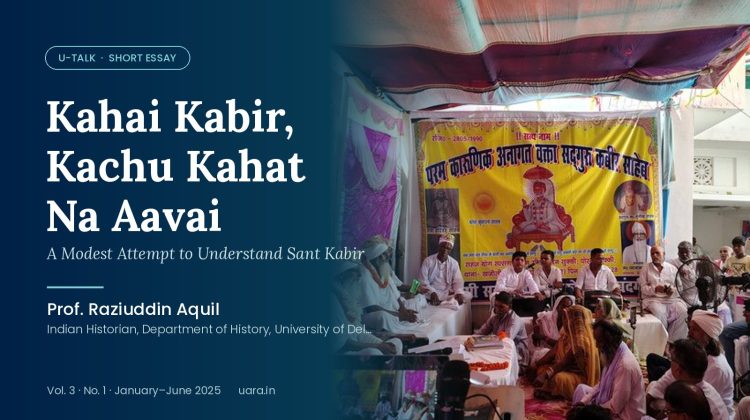
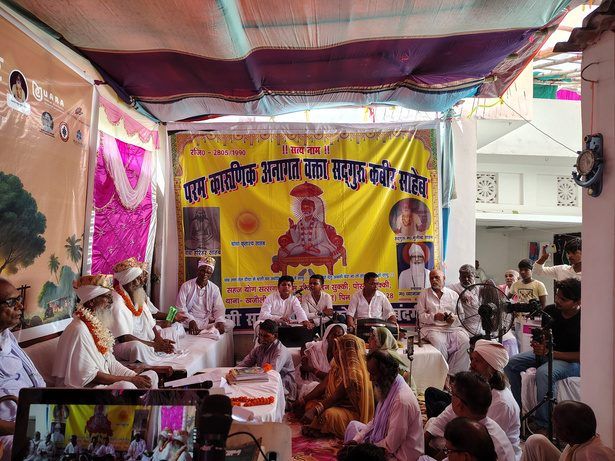
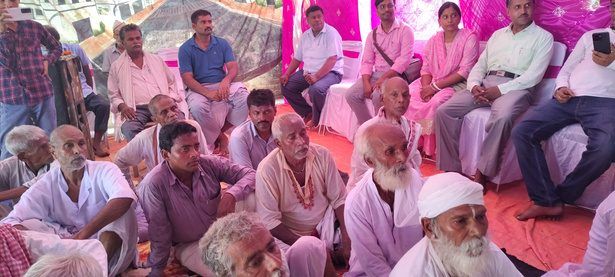
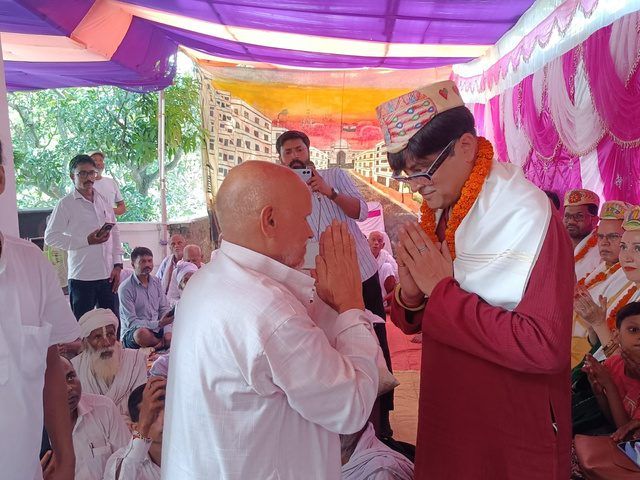
Photographs: Kahat Kabir Workshop, Sukhi village, Madhubani, Bihar (कहत कबीर वर्कशॉप, सुखी गांव, मधुबनी, बिहार)
Prof. Raziuddin Aquil is an Indian historian in the Department of History, University of Delhi, India.