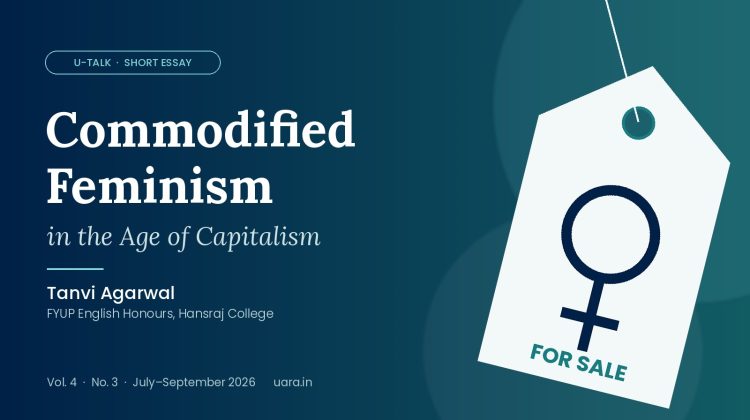
Commodified Feminism in the Age of Capitalism
~ 7 min read
In 2017, Dior launched a t-shirt carrying the phrase “We should all be Feminists,” drawing from the title of an essay written by a Nigerian author, Chimamanda Ngozi Adichie.
The t-shirt immediately became a global hit, grossing thousands of dollars from a single launch. However, luxury brands are renowned for relying on underpaid labour for several years, especially women. This paradoxical example portrays how capitalist brands often manipulate the entire idea of feminism for direct profit. How did feminism transform from a movement dedicated to dismantling oppressive systems into one of capitalism’s biggest branding strategies? In order to answer this question, one must trace back to the conflicted and tangled relation between feminism and capitalism, which eventually altered one of the most radical movements of the nineteenth and twentieth centuries into a marketable product.
How did feminism transform from a movement dedicated to dismantling oppressive systems into one of capitalism’s biggest branding strategies?
The earlier waves of feminism emerged as a critique of political and social systems. While the first wave of feminism focused primarily on achieving political and legal rights such as property ownership and voting rights, the second wave challenged and demanded interrogation of entire social systems. Thinkers such as Simone de Beauvoir and Kate Milett challenged the institutions of marriage, family, and labour, presenting them as key structures which sustained patriarchy. Second wave feminist thinkers did not encourage women to thrive within existing social systems, but rather demanded complete reformulation. Feminism was regarded as a collective struggle, aimed to deconstruct hierarchies instead of merely helping women navigate their way through them.
However, eventually the correlation between feminism and capitalism changed drastically with the rise of neoliberalism during the late twentieth century. The increase of private property, deregulation, limitation of government intervention created an entirely new economic structure. Eventually, feminist ideas and demands for independence were entangled with the new capitalist apparatus. Political philosopher Nancy Fraser argues that second-wave feminism’s emancipatory ideals were co-opted by neoliberal capitalism, particularly because of its emphasis on individual empowerment while neglecting structural economic critique. Fraser’s argument identifies the shift in feminist ideals, as neoliberal capitalism selectively appropriated feminist critiques for its own benefit. For example, the feminist critique of the traditional male breadwinner and female housewife model was adapted by neoliberal capitalism, encouraging women to enter paid labour which eventually justified flexible, low-wage labour markets. Individual advancement was celebrated and women were encouraged to fight for equality within unequal systems themselves, thus contradicting the initial demands of structural reformation.
The consequences of this shift to neoliberal feminism are evidently visible in the twenty-first century. Even when huge masses of women entered the workforce during the twentieth century, the domestic model which was heavily criticised during the earlier waves of feminism remains fundamentally unchanged.
According to the International Labour Organisation, an estimate of 708 million women worldwide remains outside the labour force because of unpaid care responsibilities, compared to just 40 million men. This stark discrepancy highlights the disproportionate role that women take in child-rearing and other domestic responsibilities. Instead of dismantling oppressive systems, neoliberal feminism simply included women into paid labour market while patriarchal institutions remained intact.
As a result, domestic burden remains fundamentally undistributed, paving the way to what is referred to as ‘double burden’ or ‘second shift’. Furthermore, the growth of social media led to the aestheticization of feminism, converting contemporary feminism into a cultural identity rather than an active political movement. Posting slogans, hashtags, news of female exploitation, critiquing political and social spheres replaced significant active action against exploitative and oppressive systems. Platforms prioritise visual appeal and emotional resonance, shifting the focus from collective liberation to individual, monetisable content like the “girlboss” or “soft girl” eras. Social media thus further accelerated this commodification of feminism. Influencers and brands reshaped profound ideologies into marketable trends and commercial assets. Feminism thus became increasingly detached from its original roots of collective emancipation and shifted towards individual empowerment within the same repressive systems, transforming into a performative act instead of notable action.
One of the most disturbing aspects of this shift is not the commodification of feminism itself, but the gradual erasure of women whose struggles initially shaped the entire movement of feminism. Feminist critic Bell Hooks argued that the first and second waves of mainstream feminism centred primarily around white, middle-class women, often completely sidelining the women of colour and lower classes. bell hooks argued that one cannot separate issues of class and racism from the mainstream feminist movement. As a result, concepts such as “womanism”, constructed by Alice Walker, emerged as an attempt to transform feminism into a more inclusive and holistic movement.
However, in the twenty-first century, one can observe how arguments of female inclusion often neglect women of lower classes, focusing mainly on middle-class corporate women. The evolution of feminist discourse through neoliberalism once again ostracised underprivileged and marginalised women from mainstream feminist critique. For example, according to the reports on the garment industry in countries such as Bangladesh, women workers occupy a large number in the workforce, manufacturing products for various international brands, often surviving under harsh working conditions, with poor wages. The Dior t-shirt serves as a crucial example of this aspect as middle and upper-class women enjoy products manufactured by marginalised women in poor and exploitative work conditions.
The commodification of feminism became exceedingly evident when corporations remodelled feminist discourse into a strategic branding tool. “Femvertising”, a term coined in 2014, refers to a marketing strategy that features the imagery of women’s empowerment. The twenty-first century witnessed numerous advertising campaigns featuring the themes of women’s empowerment. Dove’s “Real Beauty” campaign is often regarded as the pioneer of femvertising. Launched in 2004, it challenged the narrow definitions of female attractiveness by using everyday women, gaining immense popularity on a global scale, increasing the sale of Dove products enormously.
A product based on the concept of empowerment earns profit while being produced by the hands of exploited workers.
However, such branding strategies often spark debates about the ethical implications of representation and the dangers of corporations using feminist slogans as a marketing gimmick without any real implementation of gender-equal practices. High-end corporations are frequently accused of relying upon underpaid and exploited labour forces. Furthermore, apart from profiting through the means of empty slogans, brands often profit by capitalising on prejudices and insecurities of women. One of the most notable examples is the advertisement of the cream “Fair and Lovely” in India. The cosmetic brand portrayed darker skin tones as a flaw that needed to be fixed, encouraging customers to buy its products in order to fix it. While these two campaigns differ significantly from each other, both examples highlight a disturbing, yet crucial fact that women’s bodies and identities are constantly moulded into sources of profit. The remarkable success of femvertising reveals how capitalism often modifies important political movements into commodities due to their high emotional impact. Capitalism thus reconstructed feminism, from a landmark political movement to a commodity which can be marketed, sold, and purchased.
What began as an act of collective liberation eventually paved way towards individual advancement within the very systems it sought to challenge. Feminism’s conversion from a political movement to a commodity portrays capitalism’s haunting ability to reformulate central resistance into a product for sale.
The central question is not whether feminism continues to exist in contemporary times; it sure does. The central question remains whether feminism achieved its goals or drifted away from its roots somewhere along the way and transformed into a mere act of representation stripped of any meaningful action. The paradox of the Dior t-shirt captures this argument perfectly. A product based on the concept of empowerment earns profit while being produced by the hands of exploited workers. Therefore, the challenge facing feminism in the contemporary world is not its visibility, but rather the need to reclaim its original commitment to collective liberation and structural transformation. Without this, feminism simply remains another marketable brand in the hands of capitalism.
References & Image Credits
- The Illusion of Choice Feminism. (n.d.). The Student Life. tsl.news
- Sara Cwynar, Tracy (Cezanne), 2017. Source: Sleek
- Untitled (I shop therefore I am). Pinault Collection (2023, June 10). Pinault Collection
Images referenced above appear in the print/PDF edition of this essay.