The Crucible of Crisis
 Basanta Bhowmick
Student, Visva-Bharati University
~ 6 min read
Introduction
One of the most disastrous events in the history of modern India, the Bengal famine of 1943, is referred to as one of the most catastrophic events in the history of Bengal within the tumultuous backdrop of the Second World War. Based on the available data, it is said that the total estimate is between 0.3 to 0.8 million people who died due to three main reasons that is starvation, malnutrition, and associated diseases. It is one of the most horrific events that redesigned the whole structure of Bengal. Here, Bengal doesn’t mean the modern-day one; rather, it is the Bengal province of Colonial India.
Pre-Famine Vulnerabilities
As we all know that from ancient to modern India, Bengal has always become the hub of consolidation of power among the maximum rulers and always flourished in maritime Indian Ocean trade due to various cultivation factors. Bengal, which we know as ‘the land of rice growers and rice eaters,’ has to face tremendous changes due to a shift in population growth in colonial India. The implementation of Permanent Settlement has also dangerous impact on the people that only focused on the maximization of revenue. As a result, it led to stagnation in agricultural production. Based on the observation of one of the most eminent economic historian, Cormac C Grada, he argues that “margin over subsistence on the eve of famine was slender.” This created a situation where the population had to stay on minimal consumption that led to starvation, malnutrition, and the coming of new diseases that affected the people at the worst case as possible. One of the Bengali doctor, Chunilal Bose, argued that from the period of 1930, the Bengali diet or cuisine was among the least nutritious, which highlights the condition of food scarcity among Bengali people.
Wartime Exacerbation
During this period of crisis, the Second World War was at its peak, which had an immediate impact on the people. At this moment, the British were busy recruiting an army for the war, where they overlooked the needs of the civilians; they were more focused on the war rather than the humans of Bengal. At this moment, the Japanese occupied Burma in 1942, which proved to be disastrous as it permanently cut off the rice imports estimated at around 2.3 million. The war led to the stoppage of continuous food distribution through railways, but this sector also showed stagnancy that put a huge burden on the Bengalis. It is said that there was a risk of Javanese invasion on Bengal, and in reaction to this, the tracks of the eastern Bengal delta were dismantled, and any kind of food supplies and transports were banned, thousands of the boats were confiscated in the Bengal delta, economic activities become stagnant, farmers were unable to cultivate due to heavy burden of taxes. The Britishers prioritized the need to feed their army to keep it active in the war.
Colonial Policy Failure
The most important contributor to the rise of famine was the English and their failed policies; they neglected the rise of famine in Bengal and took a denialist approach towards this situation. The Britishers got continuous warnings and the signs of famine, but they overlooked them, and the worst scenario of famine began by mid-1942. In the case of providing relief, they showed ignorance towards it and completely became affirmative towards their idea of ‘no famine occurring in Bengal.’
It is proven that the government never formally declared a state of famine. They were very busy with warfare, and by November 1943, a full-fledged famine took on an enormous scale. This situation shows the colonial consciousness among the Indians, and in this famine, too, their focus was only on the maximization of the highest revenue as much as possible. From the statistical economic data, it is found that a total of 170,000 tons of Australian wheat was kept for the Greeks and the Yugoslavs. Based on the calculation of an Economist, Amartya Sen, he argued that the scarcity of food was not the only factor; it was a situation where the purchasing power of humans collapsed due to harsh colonial policies.
The scarcity of food was not the only factor; it was a situation where the purchasing power of humans collapsed due to harsh colonial policies.
Survival and Innovation
The 1943 famine marked a radical shift in culinary activities and food culture among the Bengalis. The shift is now based on the survival and minimal use of resources, wherever possible, for future use. The population pushed its limits and went beyond the existing food practices just to survive and adapt based on the condition. This famine situation forced the people to adapt to their needs based on the availability of resources. That is why this whole period could be regarded as ‘beyond unaffordable for most.’ As a result, this led to the adaptability of various food items and even changed the existing food cuisine of the Bengali household.
The list of food items that were dominant during the whole famine was as follows: The first famine food was Kochu Shaak and Googli. Kochu Shaak is basically the leaves of the taro plant, which were dominant on the banks of ponds, and they were typically stemmed during the famine. Googli are small-sized snails that are obtained from puddles and cooked in the form of broth or a normal curry.

It is important to note that its prevalence was there before famine, but it wasn’t popular; it became popular during the famine, and it is still practised even today in the modern-day Bengali household. Grass and tree leaves, such as jute leaves, which are scientifically called ‘amorphous clumps’ become popular. The leaves were stir-fried with salt and little turmeric, and a drop of oil. This dish is presently popular in some rural parts of Bangladesh, West Bengal, and the Northeast regions. Discarded parts of vegetables. The skin of various vegetables such as potato, bottle guard, and many more were used for consumption, even it is popular among everyone that the rice husk were eaten with a pinch of salt. Wild and Foraged food was used, such as the wild potato, which was boiled, and even the starch of that potato was consumed. Rice starch has become one of the most consumed foods above everything else. A saying has become commonly popular that women used to roam from one house to another in search of rice starch.
Community and Individual Survival Strategies
This famine made the people realise the strategy of survival during a harsh period of crisis, which not only changed the food culture but also the living conditions of the people. Many people of Bengal who had enough money migrated towards the urban areas in search of settlement, food, and better opportunities. This created a situation of migration syndrome among the few Bengali households. One of the most popular sayings became popular in search of rice starch was ‘the cry of phan dao’. Three main important factors prevalent during the famine were theft, destitution, and begging for food. These traumatic events are still popular in many Bengali folklores and even haunt many people till today, so it is like a situation of a ‘Bengali Holocaust’. The significant change this famine brought was that in many rural areas, the dietary practices of famine are still popular today, such as Kochu Shaak, the Googli Curry, or Chokla Bhaja.

Conclusion
This period of famine is one of the most traumatic events in the history of Bengal, which carried the most devastating testament of complex socio-economic vulnerabilities due to the primary failure of colonial policies. This man-made crisis laid its roots in the British denial policies and often regarded as the ‘catastrophic failure’ that took away the food from the common masses, it shows us how the colonial classes failure of policies had laid a huge impact on the suppressed classes of the Bengal.
This man-made crisis laid its roots in the British denial policies and often regarded as the ‘catastrophic failure’ that took away the food from the common masses
References & Credits
- Wikipedia Contributors. “Bengal Famine Of 1943.” Wikipedia, Wikimedia Foundation, 28 Feb. 2019, https://en.wikipedia.org/wiki/Bengal_famine_of_1943.
- “Famine Decimates Bengal | Research Starters | EBSCO Research.” Ebsco, 2023, https://www.ebsco.com/research-starters/nutrition-and-dietetics/famine-decimates-bengal.
- PTI. “Bengal Famine of 1943 Caused by British Policy Failure, Not Drought: Study.” The Economic Times, Economic Times, 20 Mar. 2019, https://m.economictimes.com/news/politics-and-nation/bengal-famine-of-1943-caused-by-british-policy-failure-not-drought-study/articleshow/68495710.cms.
- Famine and Freedom: The Political Evolution of Bengal During the 1943 Crisis Bijoy Mandal. https://www.irjweb.com/Famine%20and%20Freedom%20The%20Political%20Evolution%20of%20Bengal%20During%20the%201943%20Crisis.pdf.
- Tarana, Tabassum, and Sweety. The Bengal Famine of 1943: A Review of Socio- Economic and Political Aspects. https://www.historyassociation.org/admin/uploads/book/File_05F__The_Bengal_Famine__00-00.pdf.
- Siegel, Benjamin Robert, editor. “The Bengal Famine and the Nationalist Case for Food.” Cambridge University Press, Cambridge University Press, 2018, pp. 21–49, https://www.cambridge.org/core/books/hungry-nation/bengal-famine-and-the-nationalist-case-for-food/104D0A30A414AB32134F3488267AC25A.
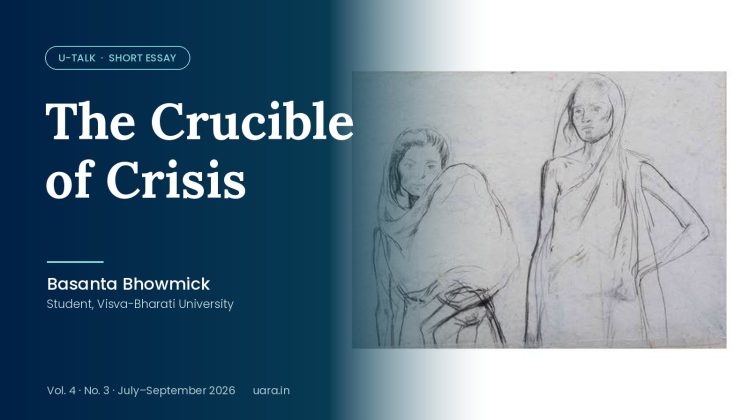
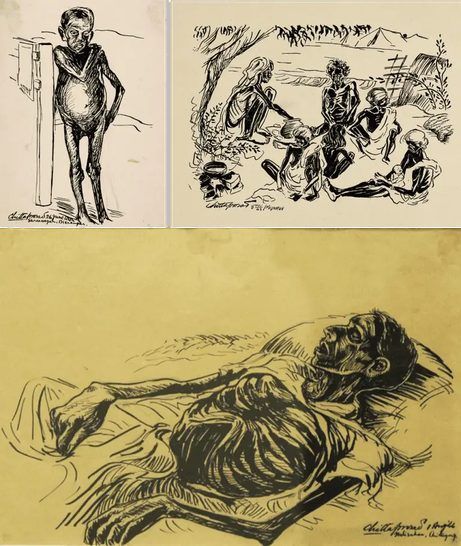
Sketches from Hungry Bengal by Chittoprasad Bhattacharya and a sketch by Hore: abirpothi.com (https://www.abirpothi.com/recording-the-horrors-of-the-bengal-famine-the-social-realist-art-of-chittoprasad-somnath-hore-and-zainul-abedin/). Famine by Atul Bose, 1943: https://www.facebook.com/PrinsepsOnline
Basanta Bhowmick is a student at Visva-Bharati University.