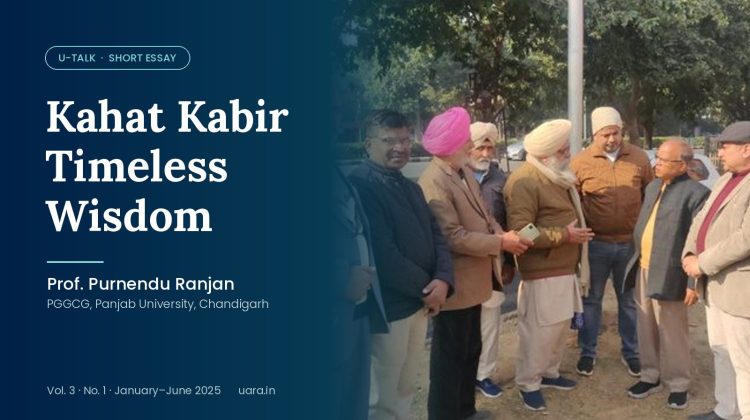
Kahat Kabir: Timeless Wisdom for Humanity
 Prof. Purnendu Ranjan
PGGCG, Panjab University, Chandigarh
~ 5 min read
“Kahat Kabir” is not merely a tagline but a profound encapsulation of Kabir’s teachings and his enduring relevance to humanity. It serves as a defining phrase that represents what Kabir signifies: a voice of truth that transcends time. Kabir speaks to us today just as he did to those in his own lifetime, and his words will continue to resonate with future generations.
For Kabir, time is inseparable from the essence of human existence. A life fully realized transcends the constraints of time. Thus, “Kahat Kabir”—what Kabir says—acts as a magnetic force, drawing humanity toward the universal truths he espoused. His teachings remain a guiding light, urging us to dismantle the divides—social, religious, political, and economic—that we have consciously or unconsciously created.
Kabir stands as a torchbearer in the midst of chaos, offering clarity and hope in a fractured world. His vision speaks to the possibility of unity amidst diversity, advocating for a life lived in its entirety. His relevance is not confined by geographical boundaries or cultural contexts; his wisdom is universal, addressing the shared struggles and aspirations of humanity.
Kabir stands as a torchbearer in the midst of chaos, offering clarity and hope in a fractured world.
In an era marked by socio-political turbulence and growing disparities, Kabir’s teachings invite us to reflect, reconcile, and rediscover the essence of our shared humanity. “Kahat Kabir” is a call to transcend divisions and embrace the wholeness of life—a timeless reminder of what it truly means to be human. To illustrate this, we turn to Kabir’s words as cited in the Guru Granth Sahib, the holy book of the Sikhs:
Awwal Allah Noor Upaya, Kudarat Ke Sab Bande
Ek Noor te Sab Jag Upaja, Kaun Bhale Kaun Mande.
(The Supreme God/Allah created the divine light, and all beings are its offspring. If the same divine light created the entire universe, how can one be deemed superior and another inferior?)
✦
This sabad by Kabir, as preserved in the Guru Granth Sahib, highlights the deeply spiritual and egalitarian essence of his philosophy. It reflects his emphasis on the interconnectedness of all beings and the inherent unity underlying creation. By stating that all living beings arise from the same divine light (Ek Noor), Kabir rejects any notion of hierarchy, discrimination, or superiority based on caste, religion, or societal divisions.
The sabad also reflects Kabir’s deep understanding of immanence, as he perceives the divine not as a distant entity but as the very essence of existence, manifesting through nature and creation. His teachings transcend religious boundaries, advocating for unity, equality, and universal brotherhood.
Kabir’s words remain profoundly relevant today, reminding us of the shared source of our existence and the futility of dividing people based on superficial differences. They encourage us to look beyond dualities and recognize the divinity and oneness in all forms of life. Despite the immense influence he wielded during his lifetime, the socio-cultural milieu of medieval India, characterized by widespread illiteracy and oral traditions, meant that much of his work and teachings were transmitted orally. This reliance on oral transmission likely contributed to the delayed and fragmented documentation of his significance.
The reference to Kabir as a muwahid—a term often associated with someone who upholds the concept of the oneness of God—underscores how his teachings resonated deeply with the monotheistic and syncretic spiritual traditions of the time. This perception of Kabir as a unifier transcended religious boundaries, appealing to both Hindu and Islamic audiences. His rejection of ritualism and caste distinctions further cemented his reputation as a radical reformer and spiritual egalitarian. Shortly after his death, in the 1520s, documented conversations describe Kabir as a muwahid of his time, as recorded by Abdul Haqq in Akhbar-ul-Akhyar (1522), based on discussions between his father and grandfather.
The mention of Kabir in Abu’l Fazl’s Ain-e-Akbari (1589) is another testament to his enduring impact. Abu’l Fazl, as the chronicler of Akbar’s court, highlighted individuals and traditions that represented harmony and inclusivity in a pluralistic society. Kabir’s inclusion in this monumental work suggests that his teachings aligned with Akbar’s vision of Sulh-e-Kul (universal peace) and religious tolerance, which was central to his administration.
Kabir’s significance, therefore, extends beyond his contemporaries. The gradual documentation of his life and teachings, starting with works like the Bijak and Guru Granth Sahib, ensured his philosophy continued to inspire generations, becoming a cornerstone of India’s spiritual and cultural heritage.
Kabir’s Influence During Modern Age
During British rule in India, Kabir’s significance was recognized by both European scholars and Indian nationalists who opposed foreign domination. Notably, W.H. Westcott and F.E. Keay wrote monographs attempting to establish the influence of Christ and Christianity on Kabir’s teachings and his followers. The eminent Orientalist H.H. Wilson even suggested that “Kabir” might not have been a single historical figure but rather a collective name for a compilation of wise sayings.
At the same time, Kabir’s philosophy found reverence among key Indian leaders. Mahatma Gandhi and Dr. B.R. Ambedkar both looked up to him, drawing inspiration from his teachings on social harmony and spiritual unity. Even after India’s independence, from Jawaharlal Nehru to Narendra Modi, the two most influential Prime Ministers of India, Kabir has been referenced as a guiding figure in safeguarding the secular credentials of the Indian state. One of Kabir’s most famous couplets encapsulates his vision of universal love and tolerance:
Mandir todo, masjid todo, yah to ek mazak hai,
Dil mat todo kisi ka vande, ye to ghar khas Khuda ka hai.
(Break a temple, break a mosque—such acts are mere folly.
But, O fellow men, never break anyone’s heart, for the heart alone is God’s true abode.)
Tragically, the world today seems to be moving in the opposite direction of Kabir’s message. The ongoing conflicts in Israel-Gaza, Ukraine-Russia, and various other regions are driven by sectarian and nationalistic strife, often in the name of protecting religious sites. Even in the land of Kabir’s birth, bloodshed and division persist, contradicting the very ideals he preached.
His words call upon us to rise above the violence of sectarianism and embrace a worldview that cherishes humanity over divisions. As we navigate the complexities of the modern world, Kahat Kabir remains an ever-relevant call for unity, love, and peace—urging us to recognize that the heart, not stone structures, is the true temple of the divine.
Kahat Kabir remains an ever-relevant call for unity, love, and peace—urging us to recognize that the heart, not stone structures, is the true temple of the divine.
Prof. Purnendu Ranjan teaches at PGGCG, Panjab University, Chandigarh, India.