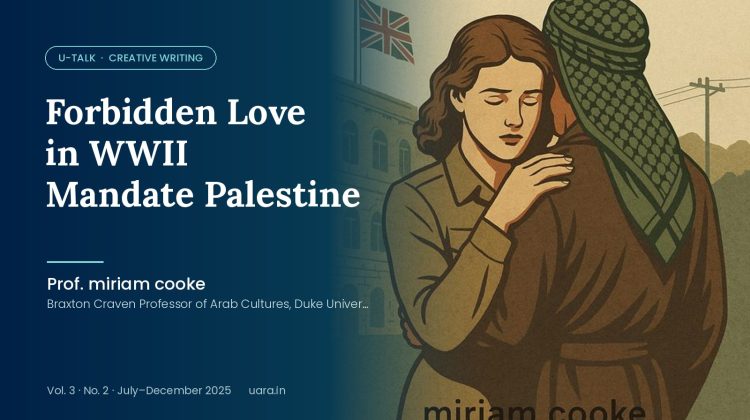
Forbidden Love in World War II British Mandate Palestine
 Prof. miriam cooke
Braxton Craven Professor of Arab Cultures, Duke University
~ 3 min read
March 15, 1944. Natanya office of the Hagana paramilitary organization in British Mandate Palestine.
Eva enters a dark windowless waiting room and takes a moment to calm her breathing and steady her shaking hands. She finds an empty chair and squeezes in between some scruffy men who are smoking and staring at her. She is the only woman there.
“Bring the bitch in,” someone shouts from behind a closed door.
A uniformed attendant opens the door to a makeshift office. She hesitates but the man waves her in impatiently. It’s going to be alright. What can they do to a Jew? Thank God Muhammad did not come. Eva pulls herself together, walks through the door and looks around the bare space, its grimy windows blocking the sunlight, so bright out there so dim in here. A small man in the far corner, hunched over a desk piled high with papers, looks up and snarls.
“Did you think you could run away with the Arab and live happily ever after?”
Happy ever after with Muhammad? Of course! She imagines his big brown eyes watching over her, urging her to be strong. There is nothing to fear. She’s done nothing wrong. But then the way this small man stares startles her. Tiny heart hammers pound against her eardrums. Her skin crawls. The thin lips stretched tight across crooked yellow teeth and the beady blue eyes release the recurring nightmare. That terrible man is leading the swastikas into the Berlin art school, the girls are screaming and running out of the school and onto the train.
Through the whirring of the ceiling fan, she hears this man say: “We abhor these relationships and so do the Arabs. We agree on this one matter, if not much else.”
He drones on and on… He wants to shame her but there is nothing shameful about their love. Indistinct wisps of words until the boom of the verdict.
“You are banished from my region. You are not to return to your family under any circumstances. Just imagine what your father will think!”
Go ahead, tell him. I don’t care. I can’t wait to leave all of this behind me.
“As for that Arab, if you go back to him you will regret it.”
Betrayed, afraid and outraged, she feels something snap inside her. It is not only their love the creep is destroying but the world in which their love had been possible. Like the Germans who had forbidden Jews from sharing space with Aryans, the Hagana is forbidding Arabs from sharing space with Jews.
It is not only their love the creep is destroying but the world in which their love had been possible.
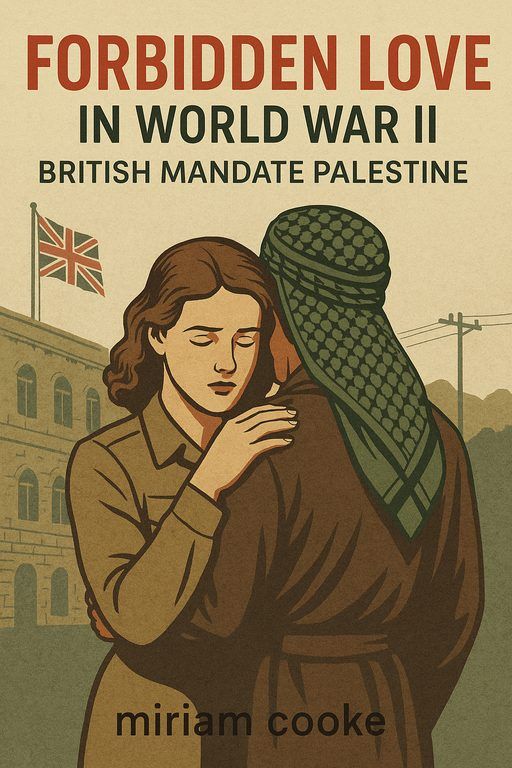
This very short story is extracted from a novel I am currently writing. It is loosely based on my mother’s traumatic encounter with the Hagana, the paramilitary organization that four years later became the Israeli Defense Force. A Jewish refugee who escaped to Palestine in 1939, she tried to adapt to the Zionist expectations of her father but failed. A passionate love affair with a Muslim Arab led to banishment from the region where her parents lived. With no other choices, she enlisted in the Auxiliary Territorial Service, the women’s branch of the British Army, where she defied pressure to work for the establishment of a Jewish nation-state on Arab land.
Her 1939 escape from Nazi Europe anticipated her subsequent escape from the ruthless Zionist project to replace indigenous Palestinian Arabs with Jews from all over the world. What my mother experienced on the eve of the establishment of Israel brings into sharp focus the lingering legacy of World War II in the eastern Mediterranean, even as it foreshadows the Israel-Palestine conflict still burning today and more than ever since October 2023 in the destruction of Gaza.
Prof. miriam cooke is Braxton Craven Professor of Arab Cultures at Duke University.