Subaltern Saint Kabir
 Dr. Ajit Kumar Jha & Dr. Deepak K. Nair
Editor-in-Chief, Pravasi Indians; with Dr. Deepak K. Nair, LNMU
~ 4 min read
In the early 1990s, I was a PhD student at UCLA, in Los Angeles, California. As the West Coast correspondent, I regularly reported for the International Edition of India Today magazine (started in 1992) about the Indian Diaspora settled in California.
While reporting a series of stories on newly constructed Hindu temples and Sikh gurudwaras in California, I came across a multi-million-dollar Mandir built in a Los Angeles suburb mainly funded by Gujaratis and Rajasthanis. When I reached the spot, I realised that the main organizers were Kabirpanthis from these two states of India. They described themselves as “Kabirpanthis and Poet Saint Dadu Dayal Bhakts.” They had collected funds from the local Indian diaspora community settled in California, comprising all religions.
They described themselves as “Kabirpanthis and Poet Saint Dadu Dayal Bhakts.” They had collected funds from the local Indian diaspora community settled in California, comprising all religions.
The Kabirpanthis in California informed me that Saint Dadu was a cotton carder from Gujarat, who later became a travelling ascetic as a young man. He ultimately settled in Rajasthan, where a community of disciples assembled around him. He believed in Siddha Yog. According to one of the organisers: “Dadu believed that God played music via our (human) breathing, perhaps the simplest form of musical instrument.”
For the first hundred years that Hinduism spread in the U.S., its followers have mainly practised the self-help approach; during the last 30 years, building Hindu temples in the U.S. has become a dominant focus. Today, all 50 states in the USA have Hindu mandirs. California is the largest and richest state, and the Indian diaspora is one of the most prosperous. California tops the list of all 50 states with 296 Hindu temples, quite a few of them several million-dollar enterprises. The Kabir temple is one of them.
My second encounter with Kabirpanthis was purely accidental. Two decades later I visited my village, Koilakh, in District Madhubani, in north Bihar to spend a long summer vacation. I was all alone since 12 families around my house had moved away to the cities. I would spend evenings on my roof to see the surrounding greenery.
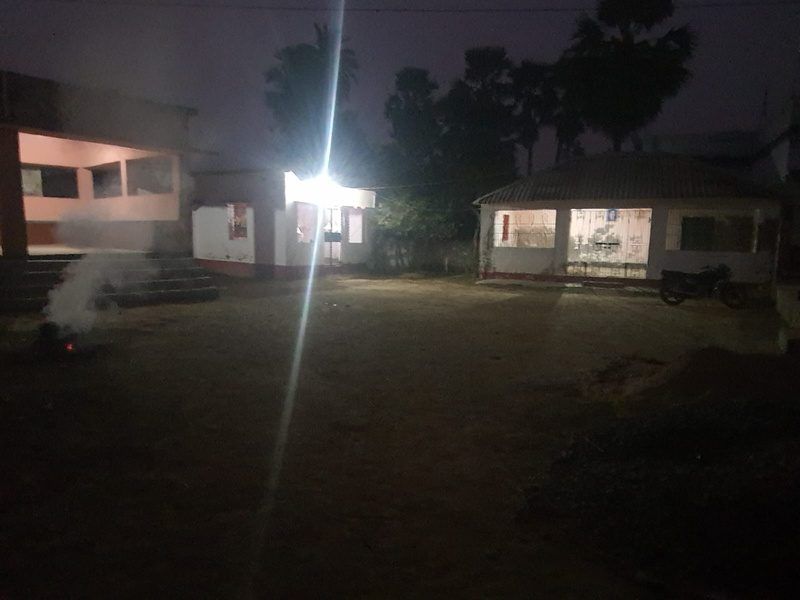
I would hear melodious bhajans from my roof and wonder about the musicians. One evening I walked in the direction of the music. Barely a quarter of a kilometre from my home I suddenly came across a gathering of almost 250 people singing bhajans with harmonium, tabla, and other musical instruments.
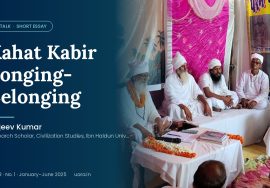
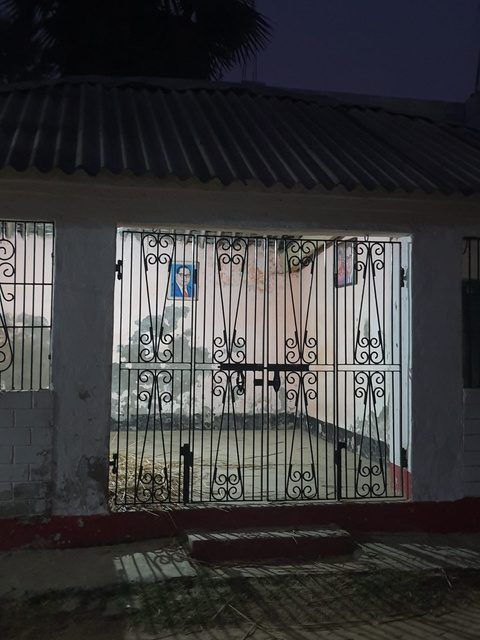
Most men were draped in white kurtas, pyjamas, and turbans, and they had beards. Peering from the iron gate, I saw a photograph of Baba Saheb Ambedkar on the wall of the simple hall which appeared as a temple.
Mesmerised by the mellifluous music, I sat a little away from the group. Someone recognised me and promptly and politely offered me a chair, but I chose to sit on the chaddar (mat), & soon, Guru Mahatma Reetlal Sau came over and began talking to me.
Guru Sau informed me they were Kabirpanthis largely from the Dushadh (Paswan) community. They were vegetarians and the majority played musical instruments and sang in a full throaty voice. The Guru had come from Muzaffarpur but most were from the neighbouring villages of Jhauwa, Rakhbari, and Berhampur.
Sant Rajendra Das, 54, of Rakhbari village told me he has been active as an organiser of the Kabirpanthis since 1984, when he was a student of class 9.
“In Koilakh, Kabirpanthis were largely from the Dushadh community, but in Jhauha village, the Kabirpanthis were from various castes: Yadavs, Khatbe, Nauwa, Teli, Suri, Mandal, and Chamars (Ravidas). Brahmins of Berhampura were also part of the Kabirpanthis,” said Sant Das.
I learnt for the first time how deeply ingrained Kabirpanthis were among subaltern classes in my village and the surrounding hamlets. Kabirpanthis, from Koilakh, believe that the 15th-century Subaltern saint (sant) challenged the moral order of Sanskritised, orthodox Brahminical Hinduism. Some Kabirpanthis consider Baba Saheb Ambedkar, Chairman of the Drafting Committee of the Constituent Assembly of India, to be “another avatar of Kabir.”
The class background of the Kabirpanthis in Koilakh village is very different from that of the Kabirpanthis and Dadu Dayal followers in California. Yet, what united them, separated by thousands of miles, is their extraordinary dedication to the mission and devotion to Kabir’s poetry and teachings.
Yet, what united them, separated by thousands of miles, is their extraordinary dedication to the mission and devotion to Kabir’s poetry and teachings.
Witnessing the Kabirpanth in Our Times: Stories of Resilience — Dr. Deepak K. Nair
Dr. Deepak K. Nair is Assistant Professor, Department of History, RNAR College, Lalit Narayan Mithila University, Bihar.
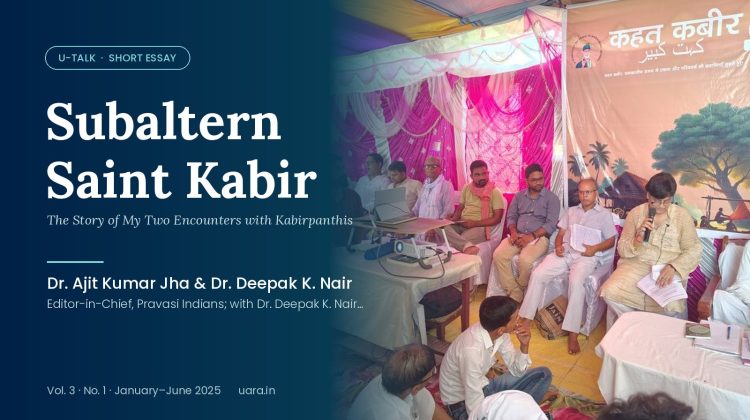
I had the opportunity to participate in the Kahat Kabir workshop organized by Mr. Rajeev, a PhD candidate at Ibn Haldun University, in the region where I work. Given my background in historical studies, I was particularly intrigued by the theme. I had read about Kabir as a Bhakti saint of the medieval period, but witnessing Kabirpanth being practiced in a remote rural area of Bihar was a novel experience. It was also enriching to listen in parallel to several established scholars from academia.
We observed a devotional music performance, an integral part of Kabirpanth, and interviewed the Kabirpanthis who participated in the workshop. One key area of inquiry for me was understanding how much the Kabirpanth we witnessed had been influenced by inter-religious practices, particularly Hinduism. I found that the philosophy and musical elements of Kabirpanth are so powerful that they not only uplift people spiritually and morally but also serve as a means of deliverance from their socio-cultural hardships.
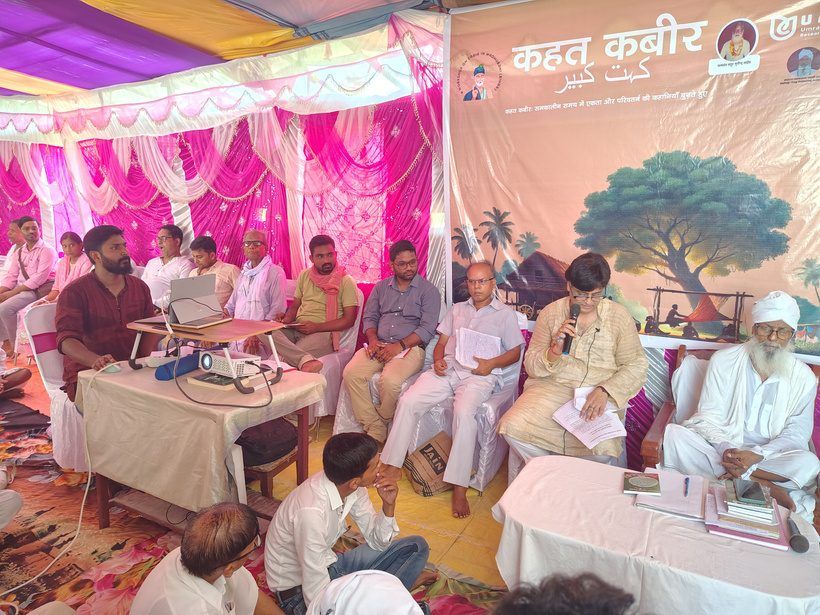
During the interviews, I was surprised to see that most Kabirpanthis had a profound knowledge of Kabir’s teachings and were prepared to engage in deep philosophical discussions, including concepts of “Brahma” and “Shabda”. The hospitality extended by the Kabirpanth Ashram in Sukhi village was beyond our expectations, and I remain deeply grateful.
This workshop aimed to understand Kabirpanth’s social implications in the region, and I believe it was a success. It allowed us to clearly identify various social processes linked to the core questions that the workshop sought to explore. Personally, I find Kabir’s teachings deeply rational—offering a unifying force that bridges religions, communities, and, above all, humanity.
Dr. Ajit Kumar Jha & Dr. Deepak K. Nair is Editor-in-Chief of Pravasi Indians, India. The accompanying piece is by Dr. Deepak K. Nair, Assistant Professor, Department of History, RNAR College, Lalit Narayan Mithila University, Bihar.