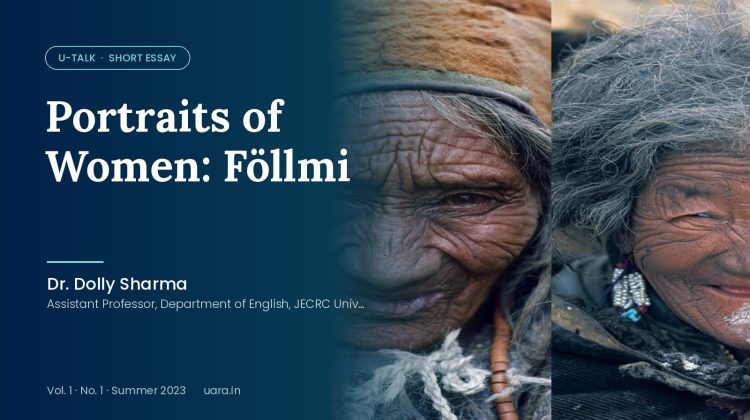
The Portraits of Women in the Oeuvre of Olivier Föllmi
 Dr. Dolly Sharma
Assistant Professor, Department of English, JECRC University, Jaipur
~ 8 min read
“Holding each other close across differences, beyond conflict, through change, is an act of resistance” (bell hooks).
Anti-racist feminists deride the rhetoric of similarity in relation to the equality of sexes. Instead, they argue for an acknowledgement of differences to vanquish white supremacy.
Photography is central to a dialogue amid scholars, artists and amateurs since the time of its inception. Notably, Walter Benjamin (1892-1940) equated photography to the novel that registers reality as it is found. Benjamin’s constant evocation of writing and image in his works lets Cadava to argue that photography is “a writing of life” (xvii). In “On Photography” (1931), Benjamin presents an admired view of photography. In “A Short History of Photography” (1913), he mentions that it is not difficult to delineate the origins of photography as it is of the print form.
This interpretation is modified by Susan Sontag (1933-2004) who compares cameras to surveillance devices. Films such as Peeping Tom (1960) indeed speak to Sontag’s claim, portraying a cameraman in the persona of a criminal who murders his figures in cold-blood with the weapon attached to the camera. Given these theoretical perspectives on photography paradoxically both as a romanticized and surveillance ridden activity, it becomes compelling to understand photography from the point of view of an informed photographer from a developed country who is interested in capturing the lives of women, from girlhood till old age. This understanding acquires greater importance when the photographer also attempts to bring the lives of women from marginalized groups to the visual medium.
This paper seeks to examine the photographs of Tibetan Buddhist women from the Himalayan region and the Hindu women from Rajasthan in the collections Homage to the Himalayas (2006) and India (2005) by the French photographer Olivier Föllmi. I take into account the following questions along the way: what motivates Föllmi to the diverse settings of the mountains and the plains to frame the female body? What strikes about the female body in the portraits captured? What level of awareness do women exhibit before getting captured by the camera lens? Did the projection have been different if women exercised their rights to decide who gets to consume their image and who does not? These sets of questions are inspired by my engagement with Annette Kuhn’s scholarship who raises critical questions of spectatorship and the prevalent interest in representing women’s bodies (4) in her book The Power of the Image: Essays on Representation and Sexuality (1985).
When it comes to the photographic endeavor in contested zones then it appears to threaten the way of life of the Tibetan Buddhist community by exposing them to public scrutiny. In this situation, one wonders whether the photographer performs his duty with ethical responsibility as every narrative of the remote group becomes available for display. Certainly, before recognizing the importance of these discussions, one needs to know the factors that propel the photographer towards his task?
Born into a middle class family, Olivier Föllmi (1957) is native to Saint-Julien-en-Genevois, France. Föllmi did his schooling in France, and his graduation in Switzerland. Föllmi told me that when he attained the age of seventeen, he was invited by a group of friends to a tour in the mountains of Afghanistan. As soon as he was there, he was mesmerized by the serenity of the mountainous landscapes. Having spent quite some time there, he developed a keen interest in rock-climbing and mountaineering. One fine day on the high mountain peaks of Kabul, Föllmi, a nineteen-year-old mountaineer, decided to earn his living by working as a tourist-guide. However, his inspiration to reach the Himalaya led him to the Zanskar range in India. After he came here, Föllmi abandoned his work as a guide to engage himself wholeheartedly in humanitarian causes. Föllmi was affected by the way in which the Tibetan Buddhist community managed to sustain itself in bare minimal resources. Thus, as soon as he met them, Föllmi set out to offer help by dropping their children to school. Föllmi also began taking photographs for which he was honoured with the World Press Award. He was impressed by the aesthetic appeal of photographs, and liked to be known as a photographer with the knowledge of aesthetics.
Föllmi reveals that he was drawn to India when he was twenty years old. He confirms that he was drawn to India inspired by her diversity and spirituality. His stint as a photographer in India began with framing the Himalayan landscape. Together with his former wife, Daniele Föllmi, he adopted four Tibetan Buddhist children who inspired him to engage deeply with Himalayan and Tibetan culture. He himself wrote to me that he is following Buddhism for at least 40 years now and his latest book My Himalaya: 40 Years among Buddhists (2018) is based on Buddha’s teachings. However, his admiration for Indian culture, his curiosity to learn and his passion for photography also led him to traverse across the Indian subcontinent which led him to photograph women from Rajasthan as well. As an aesthetic photographer, Föllmi transposes the culture of the various regions he visits to his frame which is visible in the portraits.
The photographs of women from Himalaya and Rajasthan can be analysed under three categories broadly – motherhood, feminine labour and sensual appeal. While in the first two categories (i.e., motherhood and labour), women are shown in relation to either a child or work, in the third category (sensual appeal), Föllmi captures only the face of women.
From the beginning, Föllmi shows a deep interest in taking photographs of women. He prizes the feminine sensibility above everything else. In my email correspondence with him in January, 2021 Föllmi wrote that:
“I believe I have a feminine sensibility and I feel very close to female understanding. I harbor a great respect for women. They are the guardians of wisdom and tradition, and they do not create egoistic barriers as men do. By their very nature, and the fact that they have the courage to bring life on earth, I am inspired to take photographs of women.”
They are the guardians of wisdom and tradition, and they do not create egoistic barriers as men do.
Fascinated by the mountainous landscapes and the life thriving therein, Föllmi grew passionate about exploring the aesthetics of the people who inhabit the mountains through his camera lens. He drew inspiration from the works of French photographers, Roland Michaud (1930-2020) and Sabrina Michaud (b. 1930). In Föllmi’s Himalayan photography, Tibetan Buddhist women populate the magnitude of the portraits, which is why examining their representation occupies centrality against their challenging histories.
The occupation of Tibet by the Chinese authoritarian forces in 1960 and the Tibetans’ subsequent migration to neighboring countries is concisely documented. After this outrageous attack on the dignity of the Tibetan people, the Chinese state rapidly advanced to present the Tibetan culture as antique and obscure and thus open to refinement. Such machinations make it more pressing for photographers like Föllmi to put a halt to such processes of othering which are prone to cause destruction to the marginal culture. The othering of Tibetan culture by China does not limit to turning their places of worship into antiquated museums but also by provoking them so that their anger could be shown to the world as evidence of their savage nature and brutality, notes Clare Harris. Harris mentions the 2010 Tibetan uprising when the Chinese status quo blamed Tibetans for destruction after provoking them in the first place. One could find a significant analogy to this narrative in Sherman Alexie’s (b. 1966) poem “Evolution” which shows how Indians are tempted to exchange their ancestral belongings for alcohol, and that these belongings are showcased in museums by capitalists for making money and for marking Indians’ as outmoded.
In Föllmi’s photography volumes, he seems to find the representation of the culture of the place in the portraits of women. His photographs reflect his attempt to combine nature and culture together which often transpires into occasionally taking portraits of men as well.
In the photographs that I intend to examine, Föllmi does preserve the identity markers of the female Tibetan Buddhists. I am interested in finding out what it means to distribute such photographs for the consumption of people. Why is there a need, at all, for Föllmi to capture the doubly marginalized groups – women – and keep the camera lens in front of them as surveillance devices? Are women seen as cringing or embracing the intrusion of a lens which is alien to them?
By capturing the photographs of the Tibetan people as they are, Föllmi undertakes a realistic and lifelike approach to photography rather than an idealized and romanticized one. The corporeality of the body of women becomes a major site to manifest an intimacy with one’s culture. Föllmi is a male photographer and the photographs of women are likely to be presented to the male gaze as well. Out of all the feminine sensibilities, the corporeality of the minority Tibetan women may come across as odd to the male gaze because the male gaze is habitual to looking at the white, western feminine sensibilities. Photography (as a western thing) is particularly interpellated in the sensibilities of a white, male gaze.
The corporeality of the body of women becomes a major site to manifest an intimacy with one’s culture.
For example, the following sets of photographs may evoke ugliness in the spectator, and thus the analysis of the aesthetics of ugliness in the portraits of these old women becomes pressing. In order to achieve this, I will employ the arguments of the nineteenth century German Philosopher, Karl Rosenkranz (1805-1879).
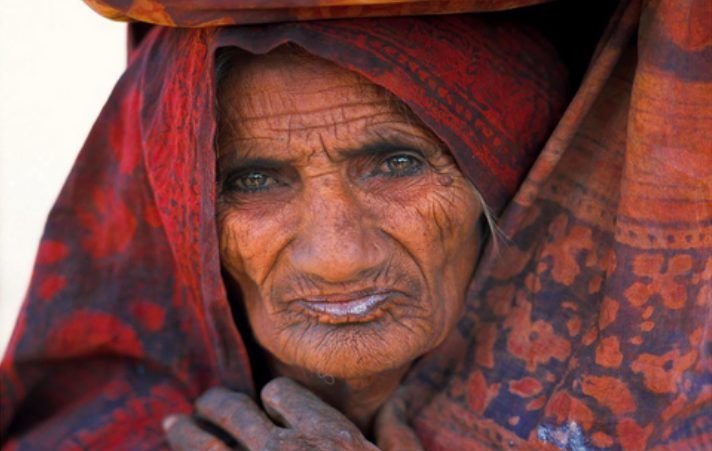
In the above portrait of an old woman from Rajasthan, Föllmi manages to click the photograph in a manner that what draws attention of the spectator are the signs of oldness in the woman such as the hard wrinkles, the dry lips and the rough hands. What appears remarkable is that Föllmi does not exclude this photograph merely because its components do not match with the conventional western understanding of beauty. Föllmi not only captures her the way she is but also lets her retain her cultural signifiers such as the head covering. If Föllmi wanted to stand faithful to the differentiation between the notions of beauty and ugliness that are typically popularized then he could have convinced the woman to reveal her head in order to contrast her bare hair with the luscious, rich hair that set the standards of beauty but he does not participate in such a process. He is part of a photographic mode that represents the noble savage as noble. The same interpretation stands true for the following sets of images of old women. In this manner, Föllmi seems to break the linkages that bell hooks derides in her observation that “There is a direct and abiding connection between the maintenance of white supremacist patriarchy in this society and the institutionalization via mass media of specific images, representations of race, of blackness that support and maintain the oppression, exploitation, and overall domination of all black people” (2).
Continued in the next issue…
Dr. Dolly Sharma is an assistant professor in the Department of English at JECRC University, Jaipur, Rajasthan.