The One Nation One Ration Card Scheme
 Aaquil Ahmed
Political Science and Economics, Jamia Hamdard University
~ 4 min read
This essay analyzes India’s “One Nation One Ration Card” (ONORC) scheme, a transformative policy that allows migrant workers to access subsidized food anywhere in the country. It applauds the program’s success in enhancing food security and transparency through technology, while also critically examining its ongoing challenges, such as the digital divide and lack of awareness, which hinder its goal of leaving no beneficiary behind.
Suppose a family of migrant workers walk out of their village in search of a better job, but with the understanding that in doing so, they will be denied the same food rations that have been keeping them safe. This was the sad state of things in India. Though our Public Distribution System (PDS) offers subsidies on food to more than 800 million people, it used to be linked to home address of a person, which rendered it useless to millions of people who migrate to work. This was to be corrected in 2019 by the launch of the scheme known as the One Nation One Ration Card (ONORC). It is a great concept, and in this essay, I would like to take a look at its goals and applaud its achievements, and in a more honest manner, I would like to see what more needs to be done to ensure that all people who require it get it.
Policy Objectives and Implementation
The very essence of ONORC was quite simple and beautiful: to provide citizens with the opportunity to purchase their food rations in any corner of the country. There were three motivations behind this reform. First, it was an effort to empower our migrant workforce in the sense that their right to food security follows them wherever they go, not only with their physical ration card. Second, it was to enable the PDS to be more effective through the application of technology to prevent leakages and filter out duplicates of beneficiaries. And lastly, it aimed to establish a new dimension of transparency and accountability in the whole food distribution network.
This wasn’t a small feat. A huge digital infrastructure linking Aadhaar to the national food security database and electronic machines in fair price shops is what makes the scheme successful. It is an enormous feat that 36 states and Union Territories have been integrated, and a single digital backbone has been established that supports a system that used to be a disjointed collection of state-specific programs.
Key Achievements and Impact
The effect of ONORC is visible in the numbers and in the stories of the people it has served. The scheme is so widespread that it processed an unbelievable 45 crore portability in 2022 alone. It was not only about convenience; in the times of the COVID-19 pandemic ONORC was a lifeline to millions of unemployed workers who did not have to decide between food and shelter.
In the times of the COVID-19 pandemic ONORC was a lifeline to millions of unemployed workers who did not have to decide between food and shelter.
On top of the raw numbers, there is another significant change introduced by ONORC but in a low-profile manner. It has made Aadhaar connected to the system hence more transparent and honest with PDS. And, with a host of ration cards being issued under the names of women, the portability aspect has silently but effectively enabled women to have a little more say on the accessibility of their family to food, even when they are not at home.
Enduring Challenges
But, as with any ambitious policy, ONORC is not flawless and there are very tangible obstacles to its success.
The Digital Divide: A technology-driven system can only be as good as technology itself. Even a bad internet connection in rural locations, technical issues, or biometrics errors may leave an individual without food, placing them in a perilous situation.
Awareness Gaps: The scheme will only benefit those people who are aware of its existence. There are too many migrant workers, mainly in the informal sectors, who are just not even aware of their rights under ONORC. This important tool cannot be accessed by many without a powerful communication push.
Operation inconsistencies: The NFSA guarantees an essential right, but states have their own regulations. The process may not be a smooth one, as a migrant may be confused by the varying types of grains or other subsidies in a new state.
Partial coverage: The scheme is only applied to individuals already covered by the NFSA. This excludes other vulnerable households, millions of whom still do not have food security and hence a lapse in the system.
Conclusion
One Nation One Ration Card is one of the most progressive initiatives which has at last acknowledged the simple human fact of migration. It combines technology to connect the social safety net of our country with each other and brings a sense of much-needed security to our mobile workforce. Its success to date stands as a strong testament to what can be achieved when policy has justice and efficiency in its focus. But the actual task is to see that no single beneficiary of this aid actually misses it, to the technical or organisational difficulties. I am personally very ardent in bridging this policy and practical gap through my own scholarly studies and practical experiences. I love the idea of being part of such an important mission.
Its success to date stands as a strong testament to what can be achieved when policy has justice and efficiency in its focus.
References & Credits
- Ministry of Consumer Affairs, Food & Public Distribution. (2023, January 10). One Nation One Ration Card (ONORC) scheme has achieved a benchmark of 45 crore transactions during the year 2022. Press Information Bureau. https://pib.gov.in/PressReleasePage.aspx?PRID=1890045
- Aggarwal, D., & Jain, S. (2020). Challenges in the Implementation of One Nation One Ration Card Scheme. Indian Journal of Public Administration. doi:10.1177/0019556120955985
- NITI Aayog. (2020). One Nation One Ration Card: A Step towards Enhancing Food Security for Migrant Workers. Policy brief. https://niti.gov.in/sites/default/files/2020-08/policy_brief_on_onorc_26_08_2020.pdf
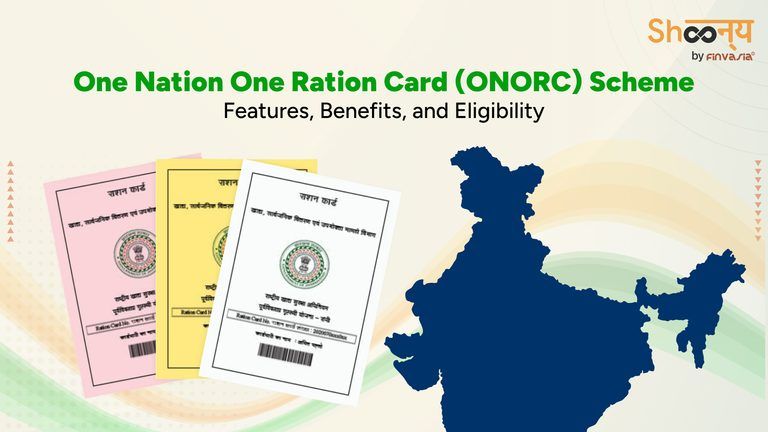
ONORC graphic: Shoonya by Finvasia (as printed in the magazine).
Aaquil Ahmed studies Political Science and Economics at Jamia Hamdard University.